


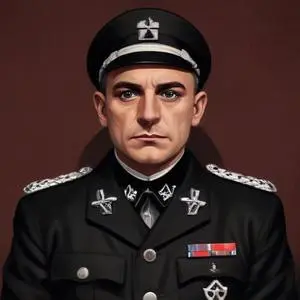
Amon Göth, an Austrian SS functionary, is notoriously known for his heinous crimes as the commandant of the Płaszów concentration camp in German-occupied Poland during World War II. His brutal and inhumane treatment of prisoners, including imprisonment, torture, and extermination, earned him a reputation as one of the most feared and reviled war criminals of the 20th century.
Göth was born on December 11, 1908, in Vienna, then the capital of the Austro-Hungarian Empire, into a family in the book publishing industry. He joined the Nazi youth group at 17 and became a member of the antisemitic nationalist paramilitary group Heimwehr (Home Guard) from 1927 to 1930.
In 1930, Göth joined the Austrian SS and was appointed an SS-Mann with the SS number 43,673. He worked for the party in the Ortsgruppe local group of the Margareten district in Vienna and soon moved to the Mariahilf Ortsgruppe, where he became a political leader in the Sturmabteilung (SA).
In 1940, Göth was appointed as the commandant of the Płaszów concentration camp, a position he held until the camp's liberation in 1944. During his tenure, he was responsible for the imprisonment, torture, and extermination of thousands of people, including Jews, Romani people, and Polish civilians.
Göth's brutal methods and regime of terror earned him the nickname "The Butcher of Płaszów." He was known for his sadistic behavior, often forcing prisoners to work long hours in inhumane conditions, and subjecting them to arbitrary and brutal punishments.
After the war, Göth was tried by the Supreme National Tribunal of Poland in Kraków and found guilty of personally ordering the imprisonment, torture, and extermination of individuals and groups of people. He was also convicted of homicide, the first such conviction at a war crimes trial.
Göth was executed by hanging on September 13, 1946, near the former site of the Płaszów camp.
Göth's crimes and brutality were immortalized in the 1993 film Schindler's List, in which he was portrayed by Ralph Fiennes. His notorious reputation has become a symbol of the horrors of the Holocaust and the atrocities committed during World War II.
Göth's legacy serves as a reminder of the dangers of prejudice, discrimination, and hatred, and the importance of upholding human rights and dignity.
Göth's life and crimes serve as a stark reminder of the devastating consequences of prejudice, discrimination, and hatred. His legacy continues to haunt us, serving as a warning of the dangers of unchecked power and the importance of promoting human rights and dignity.
Born in 1900
Leading the SS and Gestapo, he oversaw the Nazi regime's brutal security apparatus and implemented the "Final Solution," orchestrating the genocide of six million Jews during World War II.
Born in 1906
A high-ranking Nazi officer responsible for organizing the logistics of the Holocaust, overseeing the mass deportation of Jews to concentration camps during World War II.
Born in 1911
A notorious physician and captain who conducted inhumane experiments on prisoners, particularly twins, during the Holocaust, earning the nickname "Angel of Death".
Born in 1903
Austrian-German lawyer and general who served as the highest-ranking leader of the Nazi police forces, responsible for overseeing the Gestapo, SS, and concentration camps during World War II. He was a key figure in the Holocaust and other atrocities committed by the Nazi regime.
Born in 1892
A ruthless and efficient administrator who oversaw the creation and operation of Nazi concentration camps during World War II, responsible for the deaths of millions of people.
