


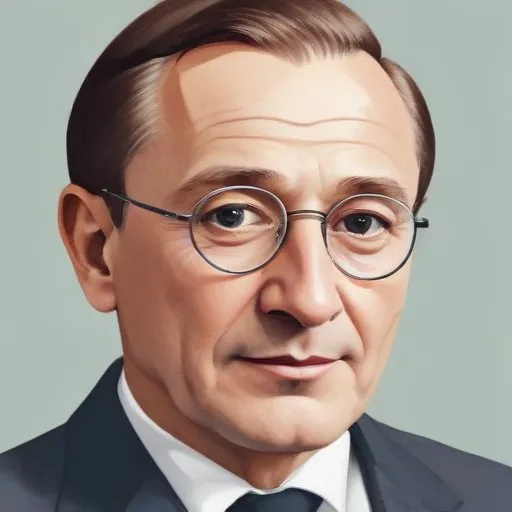
Developed groundbreaking theories in condensed matter physics, particularly in the fields of superconductivity and superfluidity. His work has far-reaching implications for materials science and quantum computing.
Anatoly Ivanovich Larkin, a Russian theoretical physicist, left an indelible mark on the realm of condensed matter theory, earning recognition as a leader in his field. His groundbreaking contributions to superconductivity, magnetism, and ferroelectricity have inspired generations of theorists, solidifying his status as a celebrated teacher and researcher.
Born on October 14, 1932, in Kolomna, Moscow region, Larkin's fascination with physics began at a young age. He pursued his passion at the Moscow Engineering Physics Institute, where he received his education and laid the foundation for his future research endeavors.
Larkin's PhD research on the properties of plasmas, under the guidance of A.B. Migdal, marked the beginning of his illustrious academic career. He later earned the degree of Doctor of Science in 1965 for his studies on superconductivity. His research at the I.V. Kurchatov Institute in Moscow (1957-1966) and the Landau Institute for Theoretical Physics in Chernogolovka, Moscow region (1966-2005), showcases his dedication to advancing theoretical physics.
During his tenure, Larkin also held the position of professor at Moscow State University (1970-1991) and later became a professor of physics at the University of Minnesota and a member of the William I. Fine Theoretical Physics Institute (1995-2005). This versatility in his academic pursuits has made him an esteemed figure in the scientific community.
Larkin's extensive bibliography comprises 233 publications, covering a wide range of topics in condensed matter theory, theory of elementary particles, and nuclei and plasmas. His work has been cited over 14,000 times, a testament to his profound impact on the field.
Larkin's dedication to teaching and mentoring has inspired a new generation of theorists. His students and collaborators, now esteemed researchers in their own right, are a testament to his exceptional mentorship. They continue to teach and conduct research in institutions around the world, ensuring Larkin's legacy endures.
In recognition of his outstanding contributions, Larkin has received numerous honors and awards. His impressive career is a testament to his unwavering commitment to advancing theoretical physics and inspiring future generations of researchers.
Anatoly Larkin's remarkable journey serves as a beacon of inspiration, illuminating the path for those who dare to venture into the fascinating realm of theoretical physics.
Born in 1921
A Soviet physicist and dissident who advocated for human rights and nuclear disarmament, earning a Nobel Peace Prize in 1975. He's known for his courageous stance against the Soviet regime, promoting peace and democracy.
Born in 1908
A renowned physicist and academic who made groundbreaking contributions to our understanding of quantum mechanics, superfluidity, and particle physics, earning a Nobel Prize in Physics in 1962.
Born in 1894
A Soviet physicist who discovered superfluidity and made significant contributions to the study of low-temperature physics, earning him a Nobel Prize in Physics in 1978.
Born in 1895
A Soviet physicist who developed the concept of the "tokamak," a device used to confine and study plasmas at extremely high temperatures, leading to advancements in nuclear fusion research.
Born in 1909
Developed mathematical methods for quantum field theory and made significant contributions to the development of theoretical physics, particularly in the areas of statistical mechanics and quantum mechanics.
Born in 1916
A Soviet physicist who made groundbreaking contributions to the theory of superconductivity and superfluidity, earning him the Nobel Prize in Physics in 2003.
Born in 1898
Developed quantum mechanics and relativity theories, making significant contributions to our understanding of space and time. His work laid the foundation for modern particle physics and cosmology.
