


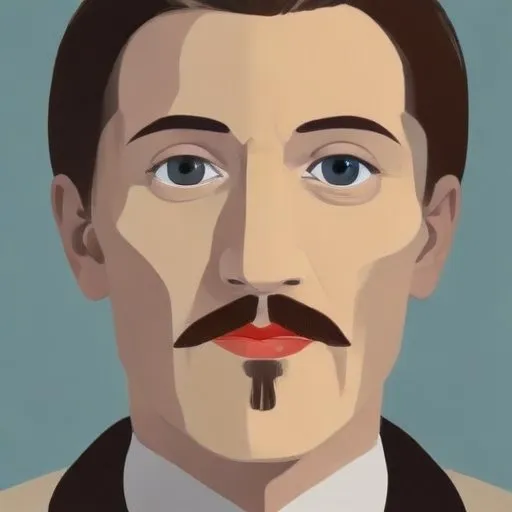
Russian painter of historical and genre scenes, capturing 17th-century Russian life with vivid colors and attention to detail.
Andrei Ryabushkin was a Russian painter renowned for his vivid depictions of ordinary Russians in the 17th century, capturing the essence of their daily lives, struggles, and triumphs. His masterpieces transport viewers to a bygone era, immersing them in the sights, sounds, and emotions of a long-forgotten time.
Born on October 29, 1861, in the village of Stanichnaya sloboda, Borisoglebskiy uezd, Tambov gubernia, Ryabushkin's early life was marked by tragedy. Orphaned at the tender age of 14, he found solace in art, a passion he shared with his father and brother, both icon painters. Fate intervened when A. Kh. Preobrazhensky, a student of the Moscow School of Painting, Sculpture, and Architecture, discovered Ryabushkin's talent and mentored him, eventually helping him secure a spot at the prestigious institution.
Ryabushkin's seven-year tenure at the Moscow School (1875-1882) saw him honing his craft under the guidance of Vasily Perov and Illarion Pryanishnikov. His breakthrough piece, Peasant Wedding, caught the attention of Pavel Tretyakov, who acquired it in 1880. This early success propelled Ryabushkin to the Imperial Academy of Arts in Saint Petersburg, where he studied under Pavel Chistyakov.
Ryabushkin's artistic voice was characterized by a deep empathy for the common man, as evident in his meticulous attention to detail and commitment to authenticity. He drew inspiration from the lives of ordinary Russians, capturing the essence of their daily struggles and triumphs. His philosophy was rooted in the belief that art should serve as a window into the human experience, rather than simply showcase technical prowess.
Ryabushkin's innovative approach and unique perspective paved the way for a new generation of Russian artists. His influence can be seen in the works of his contemporaries, including Nikolai Kasatkin and Abram Arkhipov. Today, Ryabushkin's masterpieces are invaluable artifacts of 17th-century Russian life, providing a glimpse into the country's rich cultural heritage.
Ryabushkin's legacy extends beyond his art, serving as a testament to the power of empathy and dedication to one's craft. His commitment to capturing the essence of humanity continues to inspire artists, historians, and enthusiasts alike, cementing his place as one of Russia's most beloved and revered painters.
Born in 1844
A Russian master of realism, known for vivid depictions of Russian life and history, capturing the essence of the human experience through his brushstrokes.
Born in 1848
A Russian master of historical scenes, capturing the grandeur and drama of 16th- to 18th-century Russia with vivid colors and meticulous details.
Born in 1830
A Russian painter and academic who created landscapes that evoked a sense of melancholy and nostalgia, capturing the beauty of the Russian countryside. He's particularly famous for his painting "The Rooks Have Returned" which is considered an iconic representation of Russian art.
Born in 1848
A Russian master of fantasy and folklore, creating vivid illustrations and paintings that brought mythical creatures and legends to life. His work continues to inspire artists and designers today.
Born in 1861
A Russian-French painter and set designer who blended Impressionism and Art Nouveau styles, creating vibrant, expressive works for the Ballets Russes and opera productions.
Born in 1860
A Russian painter and illustrator renowned for capturing the serene beauty of landscapes and the fleeting effects of light, evoking a sense of melancholy and nostalgia.
Born in 1856
A Russian Symbolist painter who created vibrant, dreamlike works that blended fantasy and reality, often featuring mythical creatures and folklore-inspired themes.
