


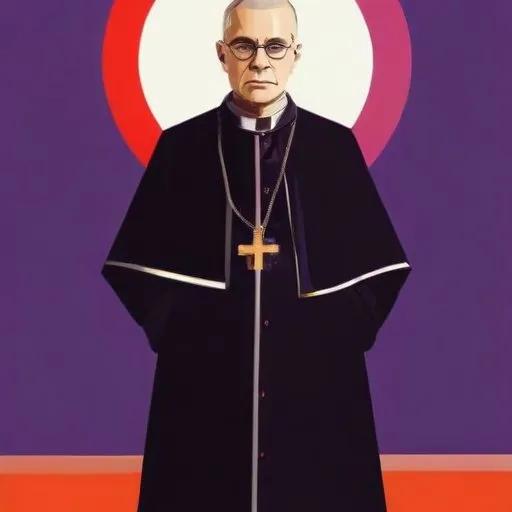
A Slovak priest and politician who played a key role in the country's independence movement and later became a leader of the Slovak People's Party, advocating for autonomy and nationalism. He's also known for his anti-Semitic views and collaboration with the Nazi regime.
Known as a champion of Catholic ethics and a fierce advocate for the Slovak national movement, Andrej Hlinka was a multifaceted individual who made significant contributions to politics, journalism, and banking in early 20th-century Czechoslovakia. As the leader of the Hlinka's Slovak People's Party, he championed the cause of the Slovak people, earning him widespread popularity and respect.
Born on September 27, 1864, in Černová, a part of the city of Ružomberok in Liptov County, Slovakia, Hlinka graduated with a degree in theology from Spišské Kapitula and was ordained as a priest in 1889. His early years as a priest saw him focus on improving the social status of his parishioners, fighting against alcoholism, and organizing educational lectures and theatre performances.
Hlinka's social activism soon led him to politics, and he became an advocate for the Slovak national movement. He founded credit and food bank associations to help ordinary people, earning him recognition and respect. In 1905, he was elected parson in Ružomberok, despite opposition from his Hungarian bishop, Sándor Prérie. This marked the beginning of his rise to prominence in Slovak politics.
Disillusioned with the Hungarian Katolikus Néppárt (Catholic People's Party), which he felt ignored Slovak demands, Hlinka, along with František Skyčák, founded the Slovak People's Party in 1913. This party would go on to become a powerful force in Slovak politics, with Hlinka at its helm.
Hlinka was a staunch defender of Catholic ethics, which he believed were under threat from secularizing tendencies and economic and political liberalism. He saw the Catholic Church as a powerful force for social change, and his party's policies reflected this belief.
Hlinka's legacy is complex and multifaceted. While he was a champion of Slovak nationalism, his party's policies have been criticized for their authoritarian and anti-Semitic tendencies. Nevertheless, his commitment to social justice and his role in shaping Slovak politics in the early 20th century cannot be denied.
Andrej Hlinka's life is a testament to the power of conviction and dedication. Despite facing opposition and criticism, he remained committed to his ideals, inspiring countless Slovaks to fight for their rights and dignity. His legacy serves as a reminder that even in the face of adversity, one person can make a difference.
Born in 1887
A Slovak priest-turned-politician who led Slovakia during World War II, implementing anti-Semitic laws and collaborating with the Nazis. He's infamous for his role in the Holocaust.
Born in 1889
The dictator of Nazi Germany, responsible for the genocide of six million Jews and millions of other people during World War II, and infamous for his extreme nationalist and anti-Semitic ideology.
Born in 1897
A mastermind of Nazi propaganda, he crafted a persuasive narrative that fueled the Third Reich's rise to power, leaving a lasting impact on the world.
Born in 1893
A German diplomat who served as the Nazi regime's Foreign Minister, orchestrating key alliances and treaties that led to World War II. He was a close associate of Adolf Hitler and played a crucial role in shaping Nazi foreign policy.
