


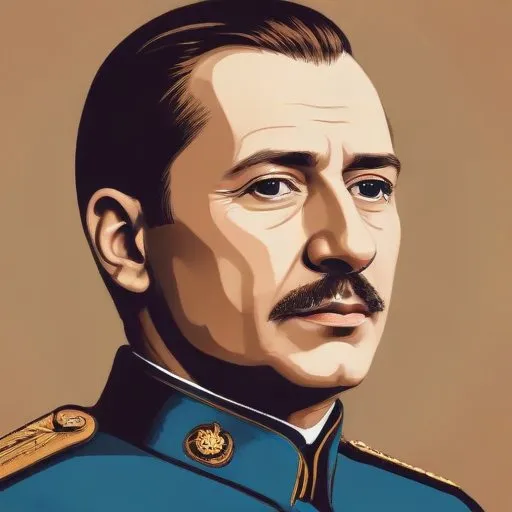
Estonian Minister of War who played a crucial role in the country's struggle for independence during the Estonian War of Independence. He's known for his military leadership and strategic thinking.
Andres Larka is renowned for his valiant efforts as a military commander during the Estonian War of Independence and his subsequent stint as a politician in the newly formed Republic of Estonia. He played a pivotal role in shaping the country's military strategy and defense mechanisms, earning him the respect and admiration of his people.
Born on March 5, 1879, in Pilistvere, Estonia (then part of the Russian Empire), Larka pursued a military career from a young age. He graduated from the Vilnius Military Academy in 1902 and later attended the Imperial Nicholas Military Academy, where he earned his degree in 1912.
After the war, Larka continued to serve his country, holding various positions including the Undersecretary of the Minister of War from 1919 to 1925. Due to health concerns, he retired from active duty in 1925.
However, his political ambitions remained strong, and in 1930, he became the official leader of the League of Liberators. He ran as a presidential candidate in the 1934 elections but was thwarted by a coup d'état led by Konstantin Päts and Johan Laidoner. Larka was imprisoned twice, from 1934 to 1935 and again from 1935 to 1937.
Andres Larka's contributions to Estonia's independence and defense are still celebrated today. He was awarded the Latvian military Order of Lāčplēsis, 2nd class, for his bravery and military prowess.
Despite facing numerous challenges and setbacks, Larka's unwavering dedication to his country and its people has cemented his place in Estonian history. He remains an inspiration to generations of Estonians, a symbol of courage, perseverance, and patriotism.
Larka's life was cut short when he passed away in imprisonment on January 8, 1943, during the Soviet occupation of Estonia. Nevertheless, his legacy continues to inspire and motivate Estonians to strive for freedom, independence, and national pride.
Born in 1874
Estonia's first president, a key figure in the country's struggle for independence from Russia, served as a unifying force during tumultuous times. He's remembered for his role in shaping Estonia's early years and its path to sovereignty.
Born in 1868
Estonia's 2nd Prime Minister, a pioneering journalist, lawyer, and politician who played a crucial role in the country's struggle for independence and development. He's most known for his efforts to establish a democratic government and promote national unity.
Born in 1884
Estonia's 7th Prime Minister, a lawyer and politician who played a crucial role in shaping the country's early years of independence, known for his diplomatic efforts and national unification.
Born in 1870
State Elder of Estonia, serving as the head of government from 1924 to 1925, known for his contributions to Estonia's early independence and development.
Born in 1886
Estonia's Head of State during World War II, leading the country's government-in-exile and advocating for independence from Soviet occupation. He played a crucial role in preserving Estonia's sovereignty and identity.
Born in 1888
Estonian journalist and politician who served as the 6th Prime Minister of Estonia, known for his leadership during the country's interwar period and his role in shaping the nation's early years of independence.
Born in 1875
Estonia's second Prime Minister, a lawyer and politician, played a crucial role in shaping the country's early years, serving as a key figure in its struggle for independence. He's most known for his efforts in establishing Estonia's sovereignty and democratic government.
Born in 1872
Estonia's 7th State Elder, a prominent lawyer and politician, played a crucial role in shaping the country's early 20th-century government and politics. He's most known for his efforts in establishing Estonia's independence and sovereignty.
