


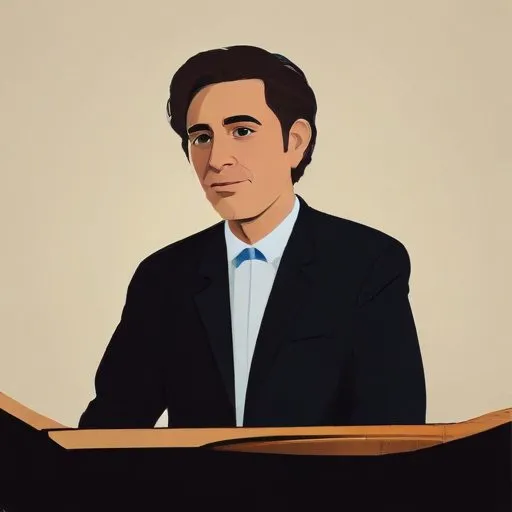
A Cypriot-American pianist, composer, and conductor who blended Eastern and Western musical styles, creating a unique sound that reflected his multicultural heritage. He was a prominent figure in the American music scene, particularly in the 1940s and 1950s.
Anis Fuleihan was a renowned Cypriot-born American composer, conductor, and pianist, celebrated for his exotic fusion of Western classical music with Middle Eastern folk influences. His vibrant compositions, often featuring instruments like the theremin, captivated audiences across the globe, earning him a reputation as a pioneer in the world of classical music.
Born on April 2, 1900, in Kyrenia, Cyprus, Fuleihan belonged to a Christian Lebanese family. He received his early education at the English School in Kyrenia, before immigrating to the United States in 1915. In New York City, he continued his piano studies under Alberto Jonas and began teaching himself composition.
Fuleihan's big break came in 1919 with the successful debut of his Oriental Fantasies at the prestigious Aeolian Hall. This triumph marked the beginning of his concert tours across the United States and the Middle East, which lasted until 1925. During this period, he also became a naturalized American citizen.
Fuleihan taught at Indiana University Bloomington from 1945, where he nurtured talented students, including composer Mary McCarty Snow. In 1953, he assumed the directorship of the Beirut Conservatory in Lebanon, followed by a stint as part of the State Department's program in Tunis, where he founded the Orchestre Classique de Tunis in 1963.
Fuleihan's compositions characteristically avoided serial structures, instead embracing the rich cultural heritage of the Middle East. His work continues to inspire new generations of composers and musicians, ensuring his legacy as a trailblazer in the world of classical music.
Fuleihan was a recipient of the prestigious Guggenheim Fellowship, a testament to his innovative contributions to the world of music.
Anis Fuleihan passed away on October 11, 1970, in Palo Alto, California, leaving behind a rich cultural heritage and a body of work that continues to enchant audiences worldwide.
Born in 1894
A Russian pianist, composer, and conductor who wrote influential music lexicons and performed avant-garde compositions, introducing audiences to modernist and experimental works.
Born in 1896
A renowned composer, conductor, and educator who made significant contributions to American classical music, particularly through his Romantic-style symphonies and leadership of the Eastman School of Music.
Born in 1897
A child prodigy turned Hollywood legend, he composed iconic film scores, including the swashbuckling adventures of Errol Flynn, and is revered for his lush, romantic music.
Born in 1896
A renowned Greek musician who excelled as a pianist, composer, and conductor, leading major orchestras and premiering numerous works. He's particularly famous for his interpretations of Mahler and his advocacy for modern classical music.
Born in 1918
A renowned musician who blended jazz, classical, and Broadway styles, creating iconic works like West Side Story, and inspiring generations with his charismatic performances and innovative compositions.
Born in 1900
A renowned composer, conductor, and educator who blended folk and modernist elements to create iconic American classical music, including "Appalachian Spring" and "Fanfare for the Common Man".
Born in 1910
A renowned pianist and composer who blended romanticism and modernism, creating iconic works like "Adagio for Strings" that evoke powerful emotions.
Born in 1910
A renowned composer and educator, he was the first president of the Juilliard School and won the Pulitzer Prize for Music in 1943. He's known for his contributions to American classical music.
