


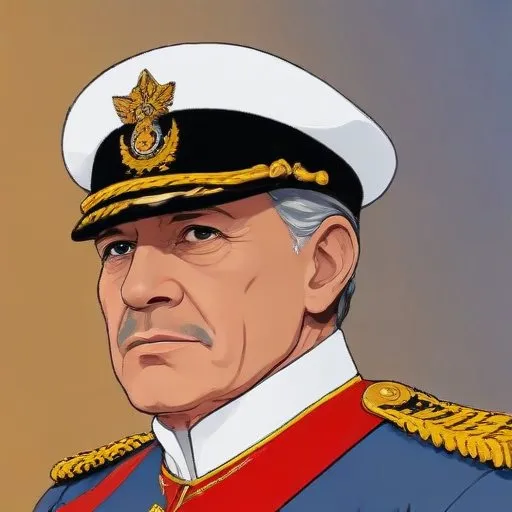
A 19th-century leader who played a key role in Argentina's struggle for independence, serving as the country's Supreme Director and leading military campaigns against Spanish royalists. He's remembered for his bravery and strategic prowess.
Antonio Gonzlez de Balcarce is renowned for his instrumental role in the Argentine War of Independence, serving as a skilled military commander and temporarily holding the position of Supreme Director of the United Provinces of the Ro de la Plata. Through his bravery and strategic mind, Balcarce secured crucial victories, paving the way for Argentina's independence from Spanish rule.
Born on June 24, 1774, in Buenos Aires, Balcarce joined the armed forces as a cadet in 1788, marking the beginning of his illustrious military career. He honed his skills in the battle for Montevideo in 1807, where he was captured by the British forces and taken to England. Following his release, he fought alongside the Spanish forces during the Peninsular War against Napoleon.
Upon his return to Buenos Aires, Balcarce participated in the May Revolution in 1810, a pivotal event that sparked the Argentine War of Independence. As second-in-command of the military campaign in the Viceroyalty of Peru, he led the victorious Battle of Suipacha on November 7, 1810, the first triumph over the Spanish royal forces.
Balcarce's military prowess and leadership skills propelled him to prominent positions, including Governor of Buenos Aires Province in 1813 and Supreme Director of the United Provinces of the Ro de la Plata ad interim in 1816. The following year, he became the Major General of the armed forces under the government of Juan Martn de Pueyrredn.
According to historian William Denslow, Balcarce was a member of the esteemed masonic lodge Lautaro. His later years were marked by his participation in the crossing of the Andes to Chile, where he served as San Martn's second-in-command during the battles of Cancha Rayada and Maipu. Unfortunately, illness forced him to return to Buenos Aires, where he passed away on August 15, 1819.
Antonio Gonzlez de Balcarce's bravery, strategic mind, and leadership played a significant role in shaping Argentina's history. His military victories and governance paved the way for the country's independence, earning him a revered place in Argentine history.
Through his remarkable life and achievements, Antonio Gonzlez de Balcarce continues to inspire and educate generations about the importance of perseverance, strategy, and leadership in pursuit of independence and freedom.
Born in 1778
Led the successful fight for independence in Argentina, Chile, and Peru, and is revered as a national hero in these countries. He's also credited with creating the Army of the Andes, a crucial force in the Latin American wars of independence.
Born in 1793
A dominant figure in 19th-century Argentina, he ruled with an iron fist, modernizing the economy and military while suppressing opposition, earning a reputation as a strong but brutal leader.
Born in 1821
A 19th-century leader who modernized Argentina's economy and infrastructure, and is also revered for his literary and journalistic contributions.
Born in 1811
A pioneering journalist and politician who modernized Argentina's education system and infrastructure, earning him the nickname "Father of Education" in Argentina.
Born in 1770
A key figure in Argentina's struggle for independence, he created the country's flag and played a crucial role in its early development.
