


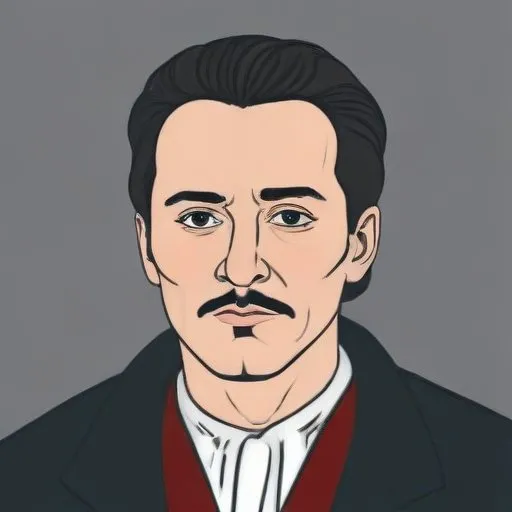
A 19th-century Russian literary figure, known for his romantic poetry and plays that often explored themes of love, nature, and Russian identity. His works are still studied and admired in Russia today.
Apollon Maykov, a renowned Russian poet, is best known for his lyric verse that showcases vivid images of Russian villages, nature, and history. His poetry is a testament to his deep love for ancient Greece and Rome, which greatly influenced his work throughout his life.
Maykov was born on June 4, 1821, in Moscow, Russia, to an artistic family. His father, Nikolay Maykov, was a talented painter and academic of the Imperial Academy of Arts. Maykov's love for literature and poetry was nurtured from a young age, and he began writing his first poetry at just 15 years old.
He received his education at home, under the guidance of prominent writers, including Ivan Goncharov. Maykov's talent and dedication earned him a place at Saint Petersburg University in 1837, where he pursued his passion for literature.
Maykov began publishing his poems in 1840, and his first collection was released in 1842. The influential critic Vissarion Belinsky praised his work, marking the beginning of Maykov's successful literary career.
Throughout his life, Maykov translated various works, including the epic "The Tale of Igor's Campaign" in 1870, and the folklore of Belarus, Greece, Serbia, and Spain. He also translated works by esteemed writers like Heine, Adam Mickiewicz, and Goethe.
Several of Maykov's poems were set to music by renowned Russian composers, including Rimsky-Korsakov and Tchaikovsky. His poetry has had a lasting impact on Russian literature, and his works continue to inspire and delight readers to this day.
Maykov's life was marked by his wavering between conservative and liberal ideologies. He was close to influential figures like Belinsky, Nikolay Nekrasov, and Ivan Turgenev during his liberal days, and later, he associated with Fyodor Dostoyevsky during his conservative periods.
Despite these shifts, Maykov maintained a consistent output of high-quality poetry, showcasing his mastery of the craft. His poetry often reflects his love for nature, history, and the human experience.
Apollon Maykov's contributions to Russian literature are immeasurable. His poetry has inspired generations of writers, poets, and artists. His love for nature and his dedication to showcasing the beauty of Russian villages and history have left an indelible mark on Russian cultural heritage.
Maykov's legacy extends beyond his poetry, as he played a significant role in promoting Russian culture and literature globally. His translations of foreign works helped introduce Russian readers to new ideas and perspectives, enriching the country's literary landscape.
Today, Maykov's poetry remains a testament to his boundless creativity, passion, and dedication to his craft. His legacy continues to inspire and influence contemporary writers, ensuring his place as one of Russia's most beloved poets.
Apollon Maykov passed away on March 8, 1897, in Saint Petersburg, leaving behind a legacy that continues to captivate and inspire readers worldwide.
Born in 1799
Russia's literary icon penned timeless tales of love, drama, and social commentary, leaving an indelible mark on the country's cultural heritage.
Born in 1814
A 19th-century Russian literary giant, known for his poignant poetry and novels that explored the human condition, particularly in the context of Russian society. His works are still widely read and studied today.
Born in 1818
A Russian literary mastermind who crafted poignant novels and plays that explored the human condition, delving into themes of love, family, and social change.
Born in 1821
A Russian literary mastermind who penned psychologically complex novels that probed the human condition, exploring themes of morality, philosophy, and the darker aspects of human nature.
Born in 1828
A Russian literary giant who penned sweeping novels like "War and Peace" and "Anna Karenina", exploring the human condition with profound insight and masterful storytelling.
Born in 1860
A renowned Russian literary mastermind, celebrated for crafting poignant, psychologically nuanced tales that probe the human condition, and pioneering the modern short story genre.
Born in 1893
A Russian avant-garde artist who revolutionized poetry and theater with his bold, futuristic style and passionate performances. He's most famous for his vibrant, propaganda-inspired posters and poems that captured the spirit of the Russian Revolution.
Born in 1880
A Russian literary giant, known for pioneering the avant-garde movement in literature, blending poetry and prose to create innovative, symbolic works that explored the human experience.
