


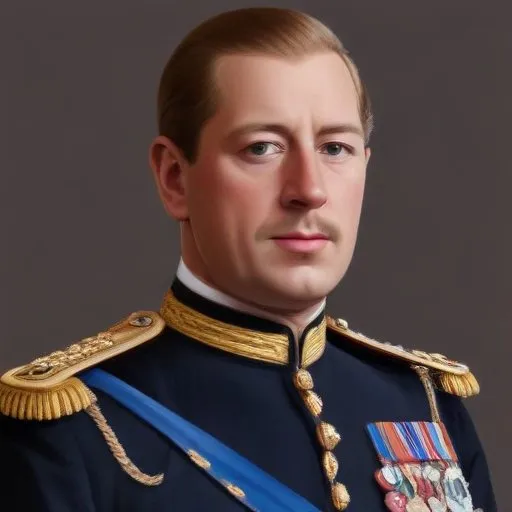
Austrian field marshal who played a crucial role in the Napoleonic Wars, reforming the Austrian army and winning several battles against Napoleon. He's also known for his military theories and writings.
Archduke Charles, Duke of Teschen, is renowned for being one of Napoleon's most formidable opponents and one of the greatest generals of the French Revolutionary and Napoleonic Wars. His exceptional military prowess, strategic mind, and unwavering dedication to the Austrian army earned him respect and admiration throughout his career.
Born on September 5, 1771, in Florence, Tuscany, Charles was the third son of Emperor Leopold II and his wife, Maria Luisa of Spain. As a member of the Habsburg royal family, Charles was destined for a life of service and duty. He began his military career fighting the revolutionary armies of France, where he quickly distinguished himself as a skilled and fearless commander.
Charles' military achievements are a testament to his tactical brilliance and ability to adapt to changing circumstances. Notable victories include Neerwinden in 1793, Amberg, Würzburg, and Limburg in 1796, and Zurich, Ostrach, Stockach, and Mannheim in 1799. These triumphs showcased his skill in executing complex and risky maneuvers, often against superior forces.
One of Charles' most significant contributions to the Austrian army was his adoption of the nation-at-arms principle, which emphasized the mobilization of entire nations rather than relying solely on professional armies. This reform helped to modernize the Austrian military and laid the foundation for future successes.
In 1809, Charles entered the War of the Fifth Coalition, where he faced off against Napoleon himself. Although he suffered a defeat at the Battle of Wagram, Charles' earlier victory at Aspern-Essling had inflicted Napoleon's first major setback. This bold challenge to Napoleon's authority earned Charles recognition as a hero of the French Revolutionary and Napoleonic Wars.
Archduke Charles, Duke of Teschen, left an indelible mark on the history of warfare and the Austrian military. His unwavering commitment to reform and innovation helped to modernize the Austrian army, making it a more formidable force on the battlefield. As a military strategist, Charles demonstrated exceptional ability, earning the respect of his contemporaries and later generations of military leaders.
In Austria, Charles is remembered as a national hero, his name etched in the annals of history as a testament to courage, perseverance, and military genius. His legacy continues to inspire and influence military thinkers to this day, a lasting tribute to his unwavering dedication to the art of war.
Article End
Born in 1830
The longest-reigning ruler of Austria-Hungary, presiding over a vast empire that spanned across Central Europe, and remembered for his role in shaping European history through diplomacy and war.
Born in 1912
The last Crown Prince of Austria-Hungary was the heir to the throne of the former Austro-Hungarian Empire, and is known for his efforts to promote European unity and cooperation. He was a prominent politician and writer who played a key role in shaping European politics after World War II.
65 Years Old
The current head of the former ruling dynasty of Austria-Hungary, he is a politician and advocate for European unity and human rights, known for his efforts to promote democracy and reconciliation.
Born in 1892
The last Empress of the Austro-Hungarian Empire, a symbol of a bygone era, known for her courage and dedication to her husband and family during World War I. She was a unifying figure, beloved by her people.
Born in 1835
A brutal colonialist who exploited the Congo Free State for rubber and ivory, causing millions of deaths and atrocities. His reign was marked by greed, violence, and human rights abuses.
