


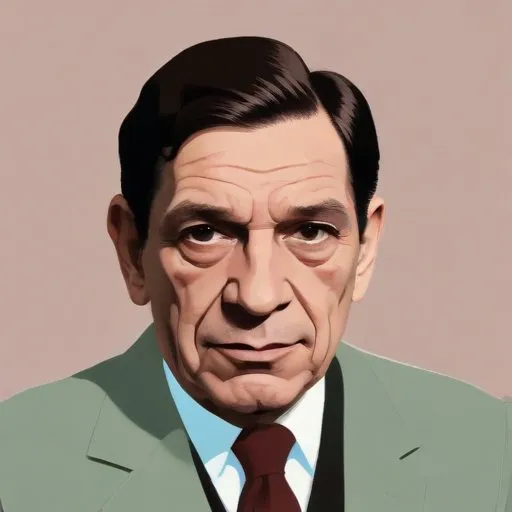
A Hungarian-English journalist and author who wrote influential novels and non-fiction books, including "Darkness at Noon", which explored the dangers of totalitarianism. He's also known for his work on parapsychology and the concept of "holons".
Arthur Koestler, a Hungarian-born author and journalist, is best known for his novel Darkness at Noon, an anti-totalitarian work that catapulted him to international fame. Through his writings, Koestler espoused numerous political causes, earning him a reputation as a vocal critic of totalitarian regimes.
Born on September 5, 1905, in Budapest, Hungary, Koestler was the son of Jewish parents, Henrik and Adele Koestler. His father, a successful businessman, had served in the Austro-Hungarian Army. Koestler's early education took place in Vienna, Austria, where he developed a passion for languages, becoming fluent in German, French, and English.
In 1931, Koestler joined the Communist Party of Germany, but his disillusionment with Stalinism led to his resignation in 1938. This experience would later influence his writing, particularly in Darkness at Noon, which depicted the Stalinist purges in the Soviet Union. Koestler's novel was published in 1940, after he had moved to Britain, and it became an instant bestseller, earning him widespread recognition.
Koestler's contributions to European culture were recognized with the prestigious Sonning Prize in 1968. He was also appointed a Commander of the Order of the British Empire (CBE) in 1972, a testament to his impact on literature and politics.
Koestler was a vocal critic of totalitarianism, and his writings reflected his strong beliefs in individual freedom and democracy. He was a fierce opponent of communism, which he saw as a threat to human rights and dignity. Through his work, Koestler aimed to expose the dangers of totalitarian regimes and promote a more just and equitable society.
Arthur Koestler married Cynthia Jefferies in 1965, and the couple remained together until his death. In 1976, Koestler was diagnosed with Parkinson's disease, and three years later, he was diagnosed with terminal leukemia. On March 1, 1983, Koestler and his wife died together at their London home, taking their own lives to avoid further suffering.
Arthur Koestler's writings have had a profound impact on modern society, inspiring future generations of writers, politicians, and social activists. His legacy extends beyond literature, with his critiques of totalitarianism influencing the global conversation on human rights and democracy. Through his work, Koestler continues to inspire and educate, a testament to his enduring impact on the world.
Koestler's literary output was vast, with numerous novels, memoirs, biographies, and essays exploring the complexities of human nature, politics, and society. His work continues to be widely read and studied, a testament to his enduring influence on literature and intellectual discourse.
Born in 1903
A renowned writer of dystopian classics, such as "1984" and "Animal Farm", who warned of totalitarianism's dangers through allegorical fiction.
Born in 1894
Author of dystopian classics like Brave New World, exploring the consequences of technological advancements on humanity. Known for prophetic warnings about government control and manipulation.
Born in 1872
A renowned thinker who made significant contributions to mathematics, philosophy, and social commentary, known for his influential writings on logic, ethics, and politics. He's a prominent figure in shaping modern intellectual thought.
Born in 1905
Existentialist philosopher and playwright who argued that humans have complete freedom to choose their actions and create their own meaning in life, influencing modern thought on morality and individual responsibility.
Born in 1889
A German philosopher and academic who explored the meaning of existence, time, and human existence, influencing 20th-century philosophy with his concept of "Being-in-the-world".
Born in 1913
A French novelist, philosopher, and journalist who wrote influential works like "The Stranger" and "The Plague", exploring absurdism and the human condition.
Born in 1908
A pioneering feminist philosopher who wrote extensively on ethics, politics, and gender, famously arguing that "one is not born, but rather becomes, a woman."
Born in 1899
A legendary writer who crafted sparse, powerful prose, capturing the human experience in novels like "The Old Man and the Sea" and "A Farewell to Arms".
