


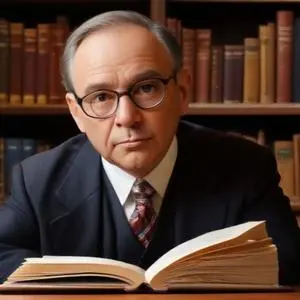
Renowned historian and critic who wrote extensively on American politics and history, particularly on the presidencies of Andrew Jackson and Franklin D. Roosevelt.
Arthur M. Schlesinger Jr. was a renowned American historian, social critic, and public intellectual, best known for his work on 20th-century American liberalism, particularly his accounts of the Kennedy administration and his critique of the "imperial presidency." As the son of influential historian Arthur M. Schlesinger Sr., he carried on his father's legacy, making significant contributions to the field of American history.
Schlesinger was born on October 15, 1917, in Columbus, Ohio, to Elizabeth Harriet and Arthur M. Schlesinger Sr. His family had a rich intellectual heritage, with his paternal grandfather being a Prussian Jew who converted to Protestantism, and his mother descending from German and New England ancestry. Schlesinger's upbringing was marked by a strong emphasis on education and intellectual pursuits.
Schlesinger's work was widely recognized and acclaimed. He won the 1966 Pulitzer Prize for Biography or Autobiography for his book A Thousand Days: John F. Kennedy in the White House, a detailed account of the Kennedy administration. This work cemented his reputation as a preeminent historian of American liberalism.
Schlesinger's writings and critiques had a profound impact on modern American society. His concept of the "imperial presidency" resonated with the public, sparking a national conversation about the limits of executive power. His work also influenced generations of historians, politicians, and social critics, shaping the way Americans think about their government and its role in society.
Schlesinger was a staunch defender of American liberalism, arguing that it was essential to the country's progress and democracy. He believed in the importance of individual liberty, social justice, and government accountability. His work reflected his commitment to these values, as he critiqued governmental abuses of power and championed the ideals of American democracy.
Schlesinger's work was not without controversy. His criticism of the Nixon administration's abuse of power sparked heated debates, and his support for the Kennedy brothers' liberal policies drew criticism from conservatives. Despite these controversies, Schlesinger remained a respected and influential voice in American intellectual circles.
"The horseman of reaction is always on the lookout for the soft spots in the American spirit." - Arthur M. Schlesinger Jr.
Schlesinger's work provides a unique window into the complexities of 20th-century American politics and society. His critiques of executive power and his championing of American liberalism continue to influence contemporary debates about governance and democracy. As a historian, social critic, and public intellectual, Schlesinger left an indelible mark on American history and intellectual life.
Schlesinger's work can be seen as part of a broader intellectual tradition of American liberalism, alongside thinkers such as John Kenneth Galbraith and DanielBell. His unique perspective and critiques, however, set him apart as a singular voice in American intellectual history.
Schlesinger's close relationships with the Kennedy brothers and other prominent liberal politicians of the time gave him unparalleled access to the inner workings of American politics. His insider perspective and personal anecdotes enliven his historical accounts, making them both informative and engaging.
Schlesinger's work has had a lasting impact on the field of American history, shaping the way historians approach the study of liberalism, executive power, and democratic governance. His critiques and insights continue to inspire new generations of scholars and intellectuals.
Arthur M. Schlesinger Jr.'s legacy as a historian, social critic, and public intellectual continues to reverberate through American intellectual life, inspiring new generations to engage with the complexities of American politics and society.
Born in 1917
The 35th President of the United States was a charismatic leader who navigated the country through the Cuban Missile Crisis and advocated for civil rights, leaving a lasting legacy in American politics.
Born in 1925
A Navy officer, lawyer, and politician who served as US Attorney General, playing a key role in the Civil Rights Movement and advocating for social justice. He was a prominent figure in American politics during the 1960s.
94 Years Old
A prominent figure in American politics, serving nearly 47 years in the Senate, championing liberal causes, and playing a significant role in shaping the country's healthcare and civil rights policies.
Born in 1908
The 36th President of the United States, a skilled politician and leader, played a crucial role in passing landmark civil rights legislation, including the Civil Rights Act and Voting Rights Act.
Born in 1913
The 37th President of the United States, a polarizing figure who led the country through significant domestic and foreign policy changes, infamous for his involvement in the Watergate scandal.
Born in 1923
A renowned diplomat and strategist who played a pivotal role in shaping global politics during the Cold War era, known for his Realpolitik approach and brokering peace agreements .
Born in 1919
Served as a key advisor to Presidents John F. Kennedy and Lyndon B. Johnson, playing a crucial role in shaping US foreign policy during the Cold War era, particularly in regards to the Vietnam War.
