


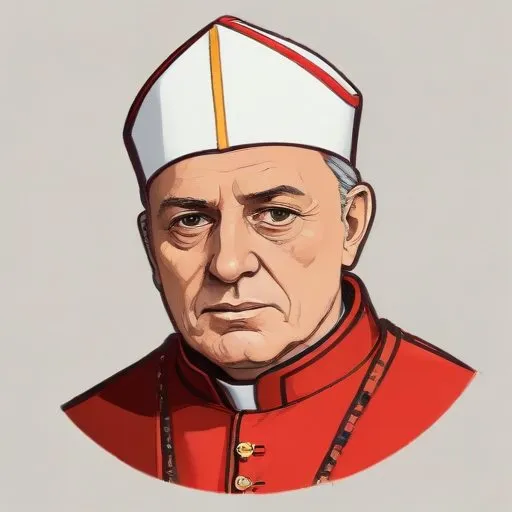
A powerful Catholic cardinal who played a crucial role in the papal conclave of 1492 and was a key figure in Renaissance politics. He was known for his cunning and diplomatic skills.
Ascanio Sforza, a prominent Italian cardinal, is renowned for his remarkable diplomatic prowess, which played a pivotal role in shaping the fate of the Catholic Church. As a master strategist, he successfully orchestrated the election of Rodrigo Borgia as Pope Alexander VI, a move that would have far-reaching consequences for the Church and its leadership.
Born on March 3, 1455, in Cremona, Lombardy, Ascanio Sforza was a member of the illustrious House of Sforza. His parents, Francesco Sforza, Duke of Milan, and Bianca Maria Visconti, raised him alongside his siblings, Galeazzo Maria Sforza and Ludovico Sforza, who would later become dukes of Milan.
Under the guidance of Francesco Filelfo, a courtier of Duke Francesco Sforza, Ascanio received a solid education in government and literature. This foundation would serve him well in his future endeavors.
At the tender age of 10, Ascanio was appointed commendatory abbot of Chiaravalle, a nod to his family's influence. Later, in 1471, Guillaume d'Estouteville promised him the red hat of a cardinal, contingent upon Galeazzo Maria Sforza's support for his papal candidacy.
Although Francesco della Rovere would ultimately be elected Pope Sixtus IV, Ascanio's promotion to cardinal was delayed. However, he persisted, eventually becoming Bishop of Pavia in 1479, a position he would retain until his death.
In 1492, Ascanio Sforza's diplomatic prowess reached new heights as he played a crucial role in the election of Rodrigo Borgia as Pope Alexander VI. This success earned him the position of Vice-Chancellor of the Holy Roman Church, a role he would hold until 1505.
During his tenure, Ascanio proved himself to be a shrewd mediator, often walking the fine line between rival factions and navigating the complex web of alliances and rivalries within the Church.
Ascanio Sforza's influence extended beyond the ecclesiastical realm, leaving an indelible mark on modern society. His diplomatic acumen and strategic thinking set a new standard for Church leaders, paving the way for future generations of clerics and statesmen.
In conclusion, Ascanio Sforza's remarkable life and achievements serve as a testament to the power of diplomacy, strategic thinking, and perseverance. His lasting impact on the Catholic Church and world history is a tribute to his unwavering dedication and unshakeable conviction.
Ascanio Sforza's remarkable life serves as a reminder that diplomacy, combined with strategic thinking and unwavering determination, can shape the course of history.
Born in 1417
A 15th-century pope who played a significant role in the fall of the Western Schism, ending the division in the Catholic Church. He's also known for his lavish spending and nepotism.
Born in 1504
Leader of the Catholic Church during the Counter-Reformation, he excommunicated Queen Elizabeth I and played a key role in the Council of Trent.
Born in 1504
Leader of the Catholic Church during the Counter-Reformation, he excommunicated Queen Elizabeth I and played a key role in the Council of Trent.
Born in 1502
Introduced the Gregorian calendar, a solar-based calendar that's widely used today, reforming the Julian calendar's inaccuracies.
Born in 1414
Established the Vatican Archives and commissioned the Sistine Chapel's ceiling, which was famously painted by Michelangelo. He also played a significant role in the Renaissance.
Born in 1568
The 17th-century Catholic leader who reigned for 21 years, known for his strong stance against Galileo Galilei and his scientific discoveries, as well as his extensive patronage of the arts.
Born in 1611
Led the Catholic Church during a tumultuous period, reforming the Church's finances and combating corruption, while also opposing the French monarch's attempts to exert control over the Church.
Born in 1431
Ruthless and cunning, this Pope was infamous for his corrupt and immoral ways, using his power to further his family's interests.
