


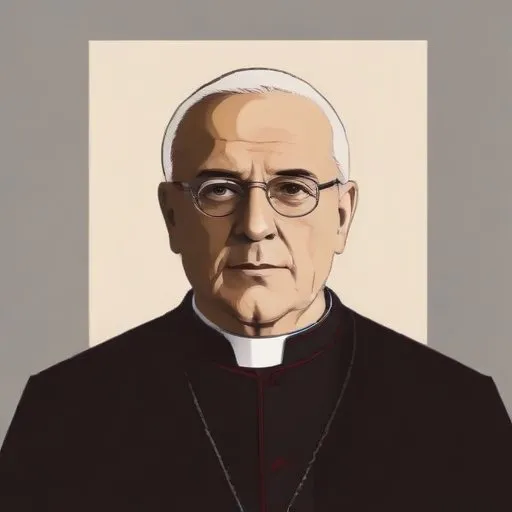
A German priest who was martyred for his faith during World War II, known for his bravery and resistance against the Nazi regime.
August Froehlich, a Roman Catholic priest from Upper Silesia, is remembered for his fearless opposition to National Socialism and his tireless advocacy for the rights of German Catholics and Polish forced laborers. His unwavering commitment to justice and humanity ultimately led to his tragic death in Dachau concentration camp in 1942.
Froehlich was born on January 26, 1891, in Knigschtte, Upper Silesia, to a well-to-do indigenous business family. He was one of six children to Johanna and Anton Froehlich, who owned the First Knigschtte Steam Mill and chaired the supervisory board of lski Bank Ludowy Krlewska Huta. After completing his education in Beuthen and Liegnitz, Froehlich began his theological studies in Breslau in 1912, with the aim of becoming a priest.
Before completing his studies, Froehlich was mobilized at the outbreak of World War I. He served in the elite 1st Emperor Alexander Guards Grenadiers and was seriously injured on the Russian front in 1915. After a miraculous recovery, he resumed his military service in France, where he was again wounded and became a prisoner of war. He was awarded the Iron Cross, first and second class, for his bravery. Froehlich returned home to Breslau from British imprisonment in 1920 and resumed his theological studies.
On June 19, 1921, Froehlich was ordained a priest by Cardinal Adolf Bertram in the cathedral of Breslau Diocese. He began his ministry in Berlin and Pomerania, where he worked as an assistant priest. During his time in Berlin, Froehlich witnessed the devastating effects of the post-war economic crisis and dedicated himself to serving the poor and marginalized.
Froehlich's outspoken criticism of the Nazi regime and his advocacy for the rights of German Catholics and Polish forced laborers made him a thorn in the side of the Nazi authorities. He campaigned tirelessly, using his pulpit to denounce the injustices and atrocities committed by the regime. Froehlich's courageous stance ultimately led to his arrest and imprisonment in Dachau concentration camp, where he died on June 22, 1942.
August Froehlich's legacy serves as a powerful testament to the importance of standing up against tyranny and oppression. His unwavering commitment to justice, compassion, and humanity continues to inspire generations. Froehlich's bravery in the face of overwhelming adversity is a shining example of the importance of moral courage and conviction.
Froehlich's heroism and sacrifice have been recognized and honored by the Catholic Church and the German government. In 2003, the German government posthumously awarded him the title of Righteous Among the Nations for his efforts to protect and aid Jewish people during the Holocaust.
August Froehlich's extraordinary life and legacy serve as a powerful reminder of the importance of moral courage, compassion, and conviction. His unwavering commitment to justice and humanity continues to inspire us today, and his heroic sacrifice will never be forgotten.
Born in 1876
The leader of the Catholic Church from 1939 to 1958, known for his controversial role during World War II, particularly in regards to the Holocaust. He is also remembered for his encyclicals on social justice and liturgical reforms.
Born in 1920
Leader of the Catholic Church from 1978 to 2005, known for helping to end communism in Poland and being a charismatic advocate for human rights and social justice.
Born in 1879
A German nobleman who served as Chancellor of Germany in 1932, known for his role in appointing Adolf Hitler as Chancellor, paving the way for the Nazi regime.
Born in 1897
The 15th Federal Chancellor of Austria, a strong opponent of Nazi Germany, who tried to maintain Austria's independence before its annexation in 1938. He's known for his courageous but ultimately unsuccessful resistance against Hitler's regime.
Born in 1892
Leader of Austria during the 1930s, implemented authoritarian regime, and assassinated by Nazi agents. Known for his anti-Nazi stance and attempts to preserve Austrian independence.
