


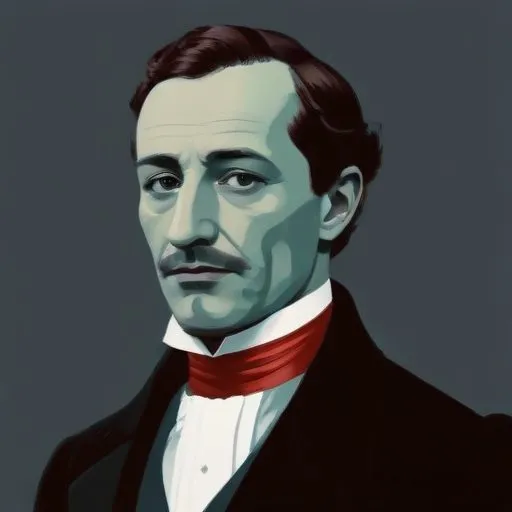
A 19th-century poet and scholar who wrote the lyrics to "Das Deutschlandlied", which became the national anthem of Germany. His works often celebrated German culture and identity.
August Heinrich Hoffmann von Fallersleben is a name synonymous with German patriotism and literature. He is best known for penning the iconic poem "Das Lied der Deutschen" (The Song of the Germans), whose third stanza has been proudly adopted as the national anthem of Germany, echoing the country's rich cultural heritage.
Born on April 2, 1798, in Fallersleben, Lower Saxony, Hoffmann von Fallersleben was the son of a merchant and mayor of his native city. He received his education at the classical schools of Helmstedt and Braunschweig, and later at the universities of Göttingen and Bonn. Initially, he aimed to study theology, but his passion for literature soon took over, and he devoted himself entirely to the world of words.
In 1823, Hoffmann von Fallersleben was appointed custodian of the university library at Breslau, a position he held until 1838. He was also made an extraordinary professor of the German language and literature at the university in 1830, and later an ordinary professor in 1835. However, his Unpolitische Lieder (Unpolitical Songs, 1840-1841) sparked controversy, offending the authorities in Prussia, and he was subsequently stripped of his chair in 1842.
During his exile, Hoffmann von Fallersleben traveled extensively throughout Germany, Switzerland, and Italy, and eventually settled in Mecklenburg, where he became a naturalized citizen. It was during this period that he penned many of his famous children's songs, which would go on to become an integral part of German cultural heritage.
After the revolution of 1848, Hoffmann von Fallersleben was able to return to Prussia, where he was reinstated to his rights and received the salary attached to a promised office not yet vacant. He married in 1849 and spent the next decade living in various cities, including Bingerbrück, Neuwied, and Weimar, where he edited the Weimarische Jahrbuch (1854-1857) alongside Oskar Schade.
Hoffmann von Fallersleben's contributions to German literature are immeasurable. His poems, songs, and writings continue to inspire generations of Germans, and his national anthem remains an enduring symbol of German identity. As a stalwart advocate for progressive ideals, his work has left an indelible mark on the country's cultural landscape.
Hoffmann von Fallersleben's remarkable life serves as a testament to the power of artistic expression and its potential to shape the course of history. His legacy continues to inspire and unite the German people, cementing his status as one of the country's most beloved and revered poets.
Born in 1749
A German literary giant who penned iconic works like "Faust" and "The Sorrows of Young Werther", shaping the Romantic movement and influencing countless writers.
Born in 1759
A renowned poet and playwright who crafted influential works that explored the human condition, morality, and the struggle for freedom, leaving a lasting impact on German literature.
Born in 1797
A 19th-century literary mastermind who penned poignant poetry and biting social commentary, known for his witty satire and romantic verses that still resonate today.
Born in 1787
A 19th-century German literary figure who wrote romantic poetry and studied medieval history and literature, known for his lyrical and patriotic works. He's a significant contributor to the German literary canon.
Born in 1830
A German literary mastermind, renowned for his poetic and dramatic works that explored the human condition, earning him the Nobel Prize in Literature in 1910.
Born in 1819
A 19th-century literary mastermind, renowned for crafting poignant novels and poetry that explored the human condition, particularly in the context of German society during the late 1800s.
Born in 1819
A 19th-century literary mastermind, celebrated for his vivid storytelling and poetic flair, particularly in his novel "Green Henry", which explores the human condition. His works are considered a cornerstone of Swiss literature.
Born in 1790
Austrian actor and playwright who wrote and performed in popular folk plays, often incorporating magic and fantasy elements, and was a key figure in Vienna's theatrical scene. He is particularly known for his humorous and satirical works that poked fun at social issues of his time.
