


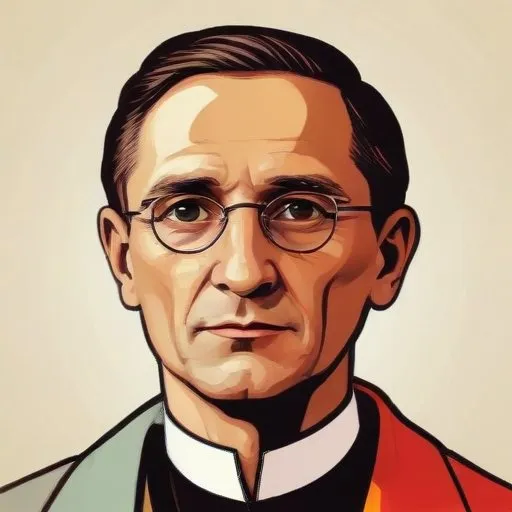
A 19th-century German historian and theologian who wrote extensively on church history, particularly the Reformation era. His works remain valuable resources for scholars today.
August Neander was a German theologian and church historian known for his groundbreaking work in Christian history, particularly his conversion from Judaism to Christianity. His writings and teachings had a profound impact on the Christian community, earning him recognition as one of the most influential theologians of his time.
Born as David Mendel on January 17, 1789, in Göttingen, Germany, Neander's early life was marked by separation from his father and upbringing in Hamburg by his mother. It was during this time that he discovered Plato, which would later influence his theological pursuits.
At the age of 17, Neander underwent a life-changing conversion to Christianity, a decision that would shape his future and writings. This transformation was deeply personal, and he was drawn to the Apostle John's writings, which resonated with him due to their similarities with Plato's philosophy.
Neander pursued divinity studies at the University of Halle under the guidance of Friedrich Schleiermacher. However, the War of the Fourth Coalition forced him to relocate to Göttingen, where he continued his studies, specializing in Plato and Plutarch, and theology under GJ Planck.
After completing his education, Neander returned to Hamburg and passed his examination for the Christian ministry. Although he initially intended to pursue a career in the ministry, he soon decided to focus on academia, driven by his desire to investigate Christian history.
Neander's most notable works include his comprehensive histories of the Christian church, which showcased his meticulous research and analytical skills. His writings not only provided a detailed account of Christian history but also offered a unique perspective on the development of Christian thought.
One of his most influential works is , which explores the life and mission of David Zeisberger, a Moravian missionary. This work demonstrates Neander's ability to weave together historical facts with theological insights, making it a valuable resource for scholars and theologians alike.
Neander's conversion and subsequent writings had a profound impact on the Christian community, inspiring others to explore the rich tapestry of Christian history. His work continues to influence theologians and historians to this day, serving as a testament to the power of faith and intellectual curiosity.
Through his writings, Neander bridged the gap between Judaism and Christianity, fostering greater understanding and empathy between these two faith traditions. His legacy extends beyond the theological realm, inspiring future generations to pursue careers in academia, ministry, and beyond.
August Neander's remarkable journey from Judaism to Christianity and his subsequent contributions to Christian history have left an indelible mark on the theological community. His legacy continues to inspire and educate, reminding us of the power of faith and intellectual curiosity to shape our understanding of the world and our place within it.
Born in 1792
A 19th-century German theologian and scholar who pioneered the historical-critical method of biblical analysis, revolutionizing the field of New Testament studies.
Born in 1804
A 19th-century philosopher who critiqued religion and idealism, arguing that God is a human creation and that people should focus on this life rather than the afterlife. His ideas influenced many prominent thinkers, including Karl Marx and Friedrich Nietzsche.
Born in 1768
A pioneering theologian and philosopher who shaped modern Christian thought and hermeneutics, known for his emphasis on individual experience and understanding of religious texts.
Born in 1770
A German philosopher and academic who developed a comprehensive and systematic philosophy that emphasized the unity of all things and the dialectical process of thesis, antithesis, and synthesis. His ideas have had a profound impact on modern thought, influencing fields such as philosophy, politics, and art.
