


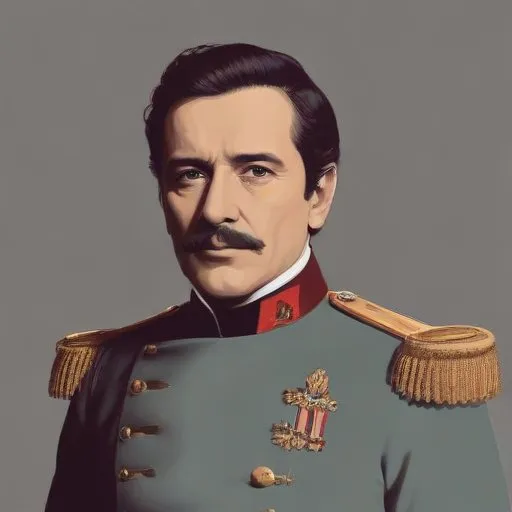
A French general and diplomat who played a key role in Napoleon's military campaigns and later served as ambassador to Russia, known for his strategic military mind and diplomatic finesse.
Augustin Daniel Belliard, comte de l'Empire, was a French general who left an indelible mark on the Napoleonic Wars, distinguishing himself in numerous battles and campaigns that shaped the course of European history. Born on May 25, 1769, in Fontenay-le-Comte, Vendée, Belliard's military prowess earned him recognition and respect from his contemporaries.
Belliard's military career began in 1792, when he joined the French Revolutionary Army under General Charles-François Dumouriez in Belgium. He later fought alongside General Lazare Hoche in Italy between 1796 and 1797, participating in the Battles of Castiglione, Caldiero, and Arcole. His bravery and tactical acumen earned him a promotion to général de brigade on November 18, 1796.
In 1798, Belliard joined Napoleon's ill-fated Egyptian expedition, where he played a crucial role in the Battle of the Pyramids. He was appointed governor of Upper Egypt and led his troops into Nubia, demonstrating remarkable military skill and adaptability in the face of unfamiliar terrain and formidable opponents.
Despite early successes, the French expedition ultimately suffered a series of defeats, culminating in Belliard's surrender on June 22, 1801, following a prolonged siege by British and Ottoman forces in Cairo. This reversal of fortunes marked a turning point in Belliard's career, as he was forced to adapt to new circumstances and realities.
Belliard returned to Europe and continued to serve under Napoleon, fighting against Austria, Prussia, and Russia in 1805. He later played a key role in the Battle of Talavera in 1809, where he commanded a small force in Madrid while King Joseph Bonaparte's army clashed with the combined British and Spanish forces.
Belliard's military campaigns and leadership have had a lasting impact on European history, shaping the course of the Napoleonic Wars and influencing the development of modern warfare. His adaptability, strategic thinking, and bravery under fire serve as a testament to his enduring legacy.
Little is known about Belliard's personal life, but his military exploits and reputation as a skilled commander have cemented his place in history. Despite the challenges and setbacks he faced, Belliard remained a dedicated and loyal servant of the French Empire, earning the respect of his contemporaries and ensuing generations.
Augustin Daniel Belliard died on January 28, 1832, in Brussels, leaving behind a legacy of military achievement and devotion to his country. His life serves as a testament to the power of courage, perseverance, and dedication, inspiring future generations to strive for greatness in the face of adversity.
assistant<|end_header_id|>Although few direct quotes from Belliard have been recorded, his military achievements and leadership style have inspired numerous anecdotes and descriptions from contemporaries and historians. One such account praises his "undaunted spirit" and "unwavering commitment" to the French Empire, capturing the essence of his exemplary military career.
Belliard's military exploits have inspired numerous artistic and literary works, including novels, films, and documentaries about the Napoleonic Wars. His name and legacy continue to fascinate historians and enthusiasts alike, ensuring his place in the annals of popular culture.
As a distinguished military officer, Belliard was awarded the title of comte de l'Empire, a prestigious honor bestowed upon him by Napoleon himself. This recognition of his service and achievements serves as a testament to his enduring legacy.
assistant<|end_header_id|>Belliard's military career and achievements can be compared to those of his contemporaries, such as Joachim Murat, Michel Ney, and Louis-Nicolas Davout. Like these renowned generals, Belliard demonstrated exceptional bravery, strategic thinking, and adaptability in the face of adversity, earning him a place among the elite of Napoleon's military leadership.
Belliard's life and military career are inextricably linked with the tumultuous period of the French Revolution and the Napoleonic Wars. His contributions to these conflicts have had a lasting impact on European history, shaping the course of modern warfare and influencing the development of military strategy and tactics. As a result, Belliard's legacy continues to inspire and educate future generations of historians, military scholars, and enthusiasts.
Although information about Belliard's personal life and charitable endeavors is scarce, his military service and dedication to the French Empire can be seen as a form of selfless contribution to the greater good. His legacy continues to inspire others to serve their countries and communities with courage and distinction.
Born in 1769
A French military leader who rose to prominence during the French Revolution and became Emperor of France, known for his military conquests and reorganization of Europe. He is also famous for his Napoleonic Code, which remains a foundation of modern law.
Born in 1767
A flamboyant and daring cavalry commander who played a key role in Napoleon's military conquests, earning the title of King of Naples.
Born in 1758
A skilled military strategist and one of Napoleon's most trusted generals, known for his victories in the Peninsular War and his role in shaping modern warfare.
Born in 1770
A renowned military strategist and statesman who played a crucial role in Napoleon's conquests and later became a key figure in French politics, known for his exceptional organizational skills and bravery.
Born in 1769
A skilled military strategist and one of Napoleon's most trusted generals, known for his bravery and tactical genius on the battlefield.
Born in 1769
A skilled and fearless military leader, known for his bravery and tactical genius on the battlefield, particularly during the Napoleonic Wars.
Born in 1763
French admiral who commanded the combined French and Spanish fleet during the Napoleonic Wars, ultimately defeated at the Battle of Trafalgar in 1805.
Born in 1764
A French military leader and politician who reformed the French army and played a key role in the Napoleonic Wars, later becoming a prominent figure in the Bourbon Restoration.
