


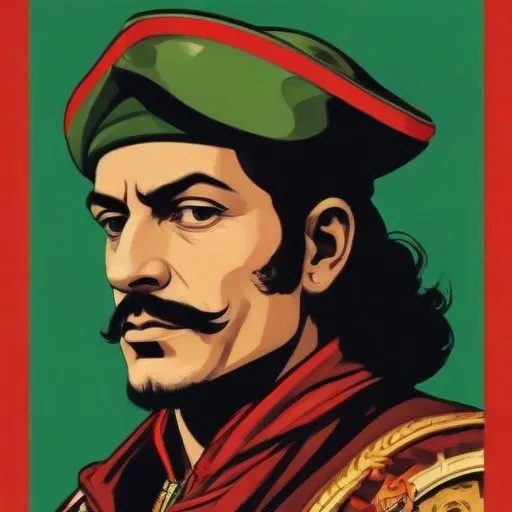
An Italian mercenary and condottiero, known for his bravery and military prowess during the Italian Wars of the 16th century, leading troops in numerous battles and sieges.
Bartolomeo Fanfulla, an Italian condottiero, is renowned for his unparalleled bravery and military prowess, having fought in almost every significant battle of the 16th century. He is particularly celebrated for his heroic deeds during the Battle of Barletta in 1503, where he, along with Ettore Fieramosca, led a contingent of thirteen Italian warriors against an equal number of Frenchmen, emerging victorious and earning the respect of the Spanish potest, Consalvo di Cordoba.
Fanfulla was born in the province of Lodi, Italy, to parents Domenico Alon and Angela Folli. He was given multiple names, including Giovanni or Giovanni Battista, Bartolomeo, and Tito, in honor of influential figures such as the Evangelical preacher and the great Roman emperor. Fanfulla's early life paved the way for his illustrious military career, which spanned over two decades.
He began as a soldier of fortune, eventually earning the title of knight and captain of a flag between 1499 and 1525. During this period, he fought on behalf of various factions, including Florence, Spain, and the Holy Roman Empire. Fanfulla's military prowess earned him recognition, and he became a respected leader, commanding a Lanza of fifty armed men who directly reported to him.
The Battle of Barletta, fought on February 13, 1503, was a defining moment in Fanfulla's career. He, along with Ettore Fieramosca, led a contingent of thirteen Italian warriors against an equal number of Frenchmen. Despite being horseless during the fight, Fanfulla fought on foot, killing the horses of the French jousters. His bravery and prowess during the battle earned him the respect and admiration of his contemporaries.
Fanfulla's heroic deeds during the Battle of Barletta have been immortalized in literature and popular culture. He is one of the main characters in Massimo d'Azeglio's novel "Ettore Fieramosca o La disfida di Barletta," written in 1833. The novel portrays Fanfulla as an astute, fun, and jolly man, cementing his place in the annals of Italian history and folklore.
Fanfulla had at least four children – MarcAntonio, Ambrosio, Giorgio, and Domenico – and nine grandchildren. His personal life was marked by his unwavering dedication to his military career, which earned him recognition and admiration from his contemporaries.
Fanfulla is considered one of the symbols of the town of Lodi and its territory. His legacy has inspired numerous local sports clubs, which take inspiration from his heroic deeds and military prowess. Today, Bartolomeo Fanfulla remains an important figure in Italian history, celebrated for his bravery, military acumen, and unwavering dedication to his country.
Fanfulla's final years were marked by continued military service. He almost certainly died on February 24, 1525, during the battle of Pavia, a testament to his unwavering commitment to his country and his profession.
In conclusion, Bartolomeo Fanfulla's illustrious career and heroic deeds have earned him a permanent place in Italian history and folklore. His bravery, military prowess, and unwavering dedication to his country have inspired generations, cementing his legacy as one of the most celebrated condottieri of the 16th century.
Born in 1475
A ruthless and cunning politician who rose to power in the Renaissance era through intrigue and military conquest, leaving a lasting legacy in politics and governance.
Born in 1480
The illegitimate child of a powerful pope, known for her ruthless politics, alleged poisonings, and scandalous marriages that shaped the Italian Renaissance.
Born in 1431
Ruthless and cunning, this Pope was infamous for his corrupt and immoral ways, using his power to further his family's interests.
Born in 1469
Italian historian and philosopher who wrote "The Prince", a seminal work on politics and power that still influences modern leadership and governance today.
Born in 1380
Unified the Crown of Aragon, ruling over a vast territory in eastern Spain, and sponsored the voyages of Christopher Columbus, leading to the discovery of the New World.
Born in 1451
Unified the Spanish kingdoms, sponsored Christopher Columbus's voyage to the Americas, and established the Spanish Inquisition.
Born in 1453
A renowned Spanish general who led successful military campaigns in Italy, earning the nickname "The Great Captain" for his innovative tactics and victories. He's most known for his conquests in Naples and Sicily.
Born in 1450
A 15th-century Italian statesman who played a key role in Florence's government, known for his diplomatic efforts to maintain peace and stability in the region.
