


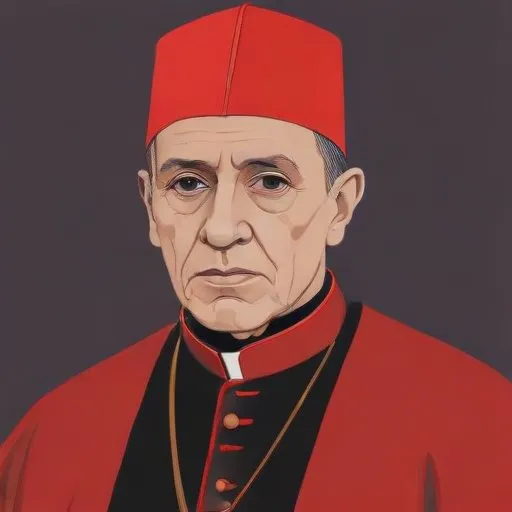
A 16th-century Italian cardinal who served as a diplomat and advisor to several popes, known for his involvement in the Council of Trent and his efforts to reform the Catholic Church.
Benedetto Accolti the Younger, also known as Il Giovane or the Cardinal of Ravenna, was a prominent Italian cardinal, bishop, and scholar of the 16th century. He was renowned for his remarkable ecclesiastical career, which spanned over two decades, and his literary contributions to the fields of poetry and theology.
Born on October 29, 1497, in Florence, Italy, Benedetto Accolti the Younger was the son of Michele Accolti, a patrician of Arezzo, and Lucrezia Alamanni. He came from a prominent family, being the nephew of Cardinal Pietro Accolti. Benedetto's early education took place at the universities of Florence and Pisa, where he developed a strong foundation in theology, philosophy, and literature.
Benedetto's ecclesiastical career began in the Roman Curia, following in the footsteps of his uncle. He was promoted to bishop of Cadiz in 1521, despite being under the canonical age of 27. He later became the bishop of Cremona in 1523 and was appointed Secretary of Pope Clement VII the same year. In 1527, he was created cardinal priest with the title of Sant'Eusebio, again succeeding his uncle.
Benedetto Accolti the Younger was a prolific writer, producing works in Latin, including poetry and theological treatises. At the request of Pope Paul III, he wrote a treatise asserting the right of the pope to the Kingdom of Naples. His literary contributions showcase his intellectual prowess and commitment to the Renaissance humanist ideals.
In 1534, Pope Paul III deprived Benedetto of his cardinalate, accusing him of misspending 19,000 ducats intended for an expedition against the Turks. However, he was restored to the cardinalate in 1535 after paying a large sum of money and agreeing to certain conditions. Despite this controversy, Benedetto Accolti the Younger left a lasting legacy in the Catholic Church, exemplifying the ideals of a Renaissance scholar and cleric.
He died on September 21, 1549, in Florence and was buried in the church of S. Lorenzo, Florence, leaving behind a testament to his remarkable life and achievements.
Born in 1535
The second shortest-reigning pope in history, serving for just 27 days in 1605, he is most known for his brief but tumultuous papacy marked by power struggles and controversy.
Born in 1536
Led the Catholic Church during a tumultuous period, issuing papal bulls and playing a key role in the Counter-Reformation. He's also famous for his coffee habit, being the first Pope to try and approve of it.
Born in 1417
A 15th-century pope who played a significant role in the fall of the Western Schism, ending the division in the Catholic Church. He's also known for his lavish spending and nepotism.
Born in 1487
A 16th-century Pope who commissioned Michelangelo to paint the Sistine Chapel's frescoes and was a patron of the arts, leaving a lasting impact on Renaissance art and architecture.
Born in 1417
A 15th-century pope who played a significant role in the fall of the Western Schism, ending the division in the Catholic Church. He's also known for his lavish spending and nepotism.
Born in 1504
Leader of the Catholic Church during the Counter-Reformation, he excommunicated Queen Elizabeth I and played a key role in the Council of Trent.
Born in 1504
Leader of the Catholic Church during the Counter-Reformation, he excommunicated Queen Elizabeth I and played a key role in the Council of Trent.
Born in 1502
Introduced the Gregorian calendar, a solar-based calendar that's widely used today, reforming the Julian calendar's inaccuracies.
