


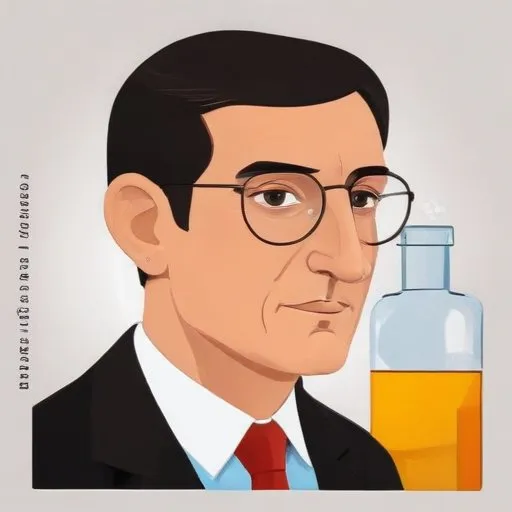
Discovered iodine in 1811 and isolated it from seaweed ash, leading to significant advancements in medicine and public health.
Bernard Courtois, a French chemist, is renowned for being the first to isolate iodine, a discovery that paved the way for the development of early photography.
In the midst of the Napoleonic Wars, Courtois found himself amidst a crisis. The French government-controlled saltpeter business was dwindling, and the shortage of wood ashes used to produce potassium nitrate had reached alarming levels. It was during this time that Courtois turned to an alternative source – seaweed – abundant on the Normandy and Brittany shores. As he delved deeper into isolating sodium and potassium compounds from seaweed ash, he stumbled upon an unusual purple vapor in 1811.
When Courtois added sulfuric acid to the seaweed ash, he was investigating the corrosion of his copper vessels. To his surprise, the acid reaction released a purple vapor, which would later become known as iodine. This chance discovery would go on to revolutionize the world of chemistry and photography.
Courtois' discovery did not go unnoticed. The prominent chemists of the time, Humphry Davy and Joseph Louis Gay-Lussac, acknowledged him as the true discoverer of iodine. In 1822, Courtois began manufacturing high-quality iodine and its salts, solidifying his place in the annals of chemistry.
In 1831, Courtois was awarded 6,000 francs as part of the Montyon Prize by L'Académie royale des sciences, recognizing the medicinal value of the element he had discovered. Though he struggled financially throughout his life, Courtois' legacy continued to grow, eventually earning him a place among the pioneers of modern chemistry.
Courtois' personal life was marked by financial struggles, which continued until his death on September 27, 1838, at the age of 61. Despite the challenges he faced, Courtois remained dedicated to his work, leaving behind a lasting impact on the world of chemistry and photography.
Today, Bernard Courtois is remembered as a pioneer in the field of chemistry, whose accidental discovery of iodine continues to inspire and influence generations of scientists and photographers.
Born in 1743
Father of modern chemistry, discovered oxygen, and developed a systematic method of chemical nomenclature. He laid the foundation for modern chemistry and paved the way for future scientific discoveries.
Born in 1742
A pioneering pharmaceutical chemist who discovered oxygen, chlorine, and other elements, and made significant contributions to the field of chemistry.
Born in 1778
Pioneering chemist and physicist who discovered several elements, including potassium and sodium, and invented the Davy lamp, a safety lamp for miners. His groundbreaking work laid the foundation for modern chemistry and electrochemistry.
83 Years Old
A British bassist who played with bands like The Levellers and Faithless, known for his energetic stage presence and distinctive bass lines.
Born in 1776
Formulated the molecular hypothesis, which states that equal volumes of gases at the same temperature and pressure contain an equal number of molecules. This concept is fundamental to understanding chemistry and physics.
Born in 1852
Discovered the element fluorine and developed an electric arc furnace, earning a Nobel Prize in Chemistry in 1906.
