


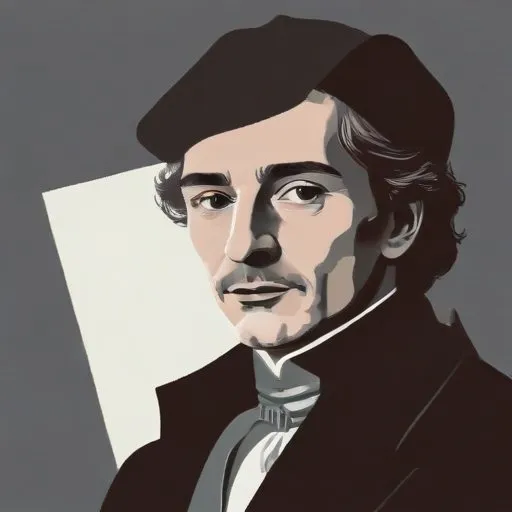
A 17th-century French poet and playwright who wrote witty, conversational dialogues and pioneered the genre of philosophical fiction, exploring scientific and philosophical ideas in an accessible way.
Bernard Le Bovier de Fontenelle, a French author, and member of three academies of the Institut de France, is renowned for his lucid and engaging writings on scientific topics, making him a pioneer in the Age of Enlightenment.
Fontenelle's works not only popularized scientific knowledge among the general public but also defended the Cartesian tradition, earning him a prominent place in the annals of scientific history.
Born on February 11, 1657, in Rouen, France, Fontenelle was the nephew of the famous French dramatists Pierre and Thomas Corneille. His father, François le Bovier de Fontenelle, was a lawyer who worked in the provincial court of Rouen.
Fontenelle received his education at the college of the Jesuits, the Lycée Pierre Corneille, where he demonstrated a strong inclination towards literature and distinguished himself among his peers.
Fontenelle began his literary career as a poet, composing a poem in Latin at the tender age of 13. He later became acquainted with prominent figures such as the abbé de Saint-Pierre, the abbé Vertot, and the mathematician Pierre Varignon.
During his time in Paris, Fontenelle frequented the Academia Parisiensis, where he met influential thinkers like Father Marin Mersenne, Gassendi, Descartes, Hobbes, Roberval, and the two Pascals, father and son.
Fontenelle's most notable work is his Conversations on the Plurality of Worlds, which presents scientific knowledge in a conversational style, making it accessible to a broader audience. This work not only reflects his Cartesian leanings but also showcases his ability to simplify complex scientific concepts.
Fontenelle was a prolific writer, producing numerous works on various subjects, including philosophy, astronomy, and mathematics. His writings often reflected his commitment to the Cartesian tradition, and he was not afraid to engage in controversy when defending his views.
Fontenelle's contributions to the field of science are undeniable, and his works had a profound impact on the development of scientific thought during the Enlightenment. He was elected to three academies of the Institut de France, a testament to his reputation as a respected author and scientist.
His writings continue to inspire generations of scientists, philosophers, and thinkers, and his legacy as a champion of accessible scientific knowledge remains unchallenged.
Fontenelle was a staunch defender of the Cartesian tradition, and his works often reflected his commitment to this philosophical school of thought. He believed in the importance of reason and empirical evidence in scientific inquiry.
Fontenelle's philosophical contributions extend beyond his scientific works, as he also wrote on topics such as morality, ethics, and aesthetics, showcasing his vast intellectual range.
Born in 1694
A witty and insightful 18th-century writer and philosopher who used satire to critique societal norms and advocate for reason, tolerance, and human rights.
Born in 1622
A 17th-century master of comedy, he penned witty plays that satirized the French aristocracy, leaving a lasting impact on Western theater. His works remain widely performed and adapted today.
Born in 1639
A 17th-century master of French tragedy, crafting intricate, psychologically complex dramas that probed the human condition, influencing the development of Western theatre.
Born in 1606
A 17th-century French mastermind behind iconic plays like "Le Cid" and "Horace", known for pioneering the classical French tragedy genre.
Born in 1621
A 17th-century master of fables, crafting witty, moral tales that entertain and educate, still widely read and adapted today.
Born in 1636
A 17th-century French poet and critic who advocated for reason and morality in literature, and is known for his influential writings on poetry and aesthetics.
Born in 1628
A 17th-century French author and academic who wrote beloved fairy tales, including "Cinderella" and "Sleeping Beauty", that have become timeless classics.
Born in 1712
A pioneering thinker who shaped modern democracy and education with his ideas on social contracts, general will, and the importance of early childhood education. His writings influenced the French Revolution and modern political thought.
