


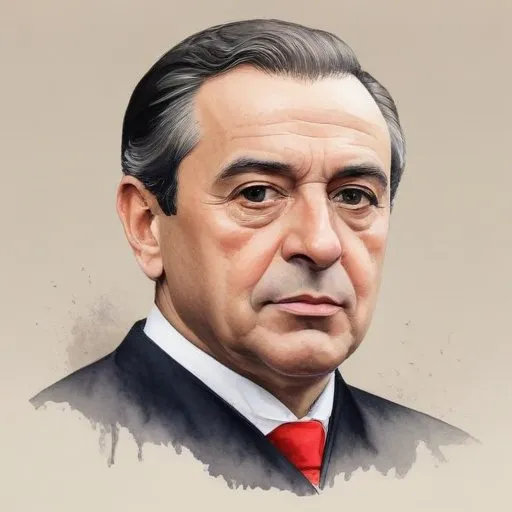
A Portuguese academic and politician who served as the 3rd President of Portugal, known for his efforts to modernize and democratize the country during a tumultuous period in its history. He played a key role in shaping Portugal's path towards republicanism and democratic governance.
Bernardino Machado, the third and eighth President of Portugal, was a prominent political figure who left an indelible mark on the country's history. This statesman is widely recognized for his significant contributions to Portugal's development, serving two non-consecutive terms from 1915 to 1917 and again from 1925 to 1926.
Born in Rio de Janeiro, Brazil, on March 28, 1851, Bernardino Machado was the son of António Luís Machado Guimarães, a nobleman of the royal household, and his second wife, Praxedes de Sousa Guimarães. Machado moved to Portugal in 1860 and enrolled at Coimbra University in 1866, where he studied mathematics and philosophy, graduating in 1873.
It was through his association with the Regenerator Party, led by Fontes Pereira de Melo, that Machado began his foray into politics. He was first elected as a deputy to the Portuguese parliament for Lamego in the supplementary elections of 1882. His rapid rise within the party ranks saw him become a prominent figure in Portuguese politics.
During his first term as President, Machado focused on implementing reforms aimed at modernizing Portugal's infrastructure, economy, and education system. However, his presidency was cut short when Sidónio Pais, the head of a military junta, dissolved Congress and forced Machado into exile in 1917.
In 1925, Machado returned to the presidency, seeking to complete the reforms he had initiated during his first term. However, his second presidency was also marked by turmoil, and he was overthrown by the military revolution of 28 May 1926, which paved the way for the establishment of the Estado Novo dictatorship.
Bernardino Machado's legacy is complex and multifaceted. While his presidencies were marked by turmoil and instability, he played a significant role in shaping Portugal's modernization and development. His commitment to education, infrastructure, and economic reforms continues to influence Portuguese society today.
In 1882, Machado married Elzira Dantas Gonçalves Pereira, with whom he had 18 children. One of his sons-in-law was the renowned writer Aquilino Ribeiro, whose son, Aquilino Ribeiro Machado, went on to become the first mayor of Lisbon after the Carnation Revolution.
Bernardino Machado's life and legacy serve as a testament to his unwavering commitment to Portugal's progress. Despite facing numerous challenges and setbacks, he remained dedicated to his vision for a modern, prosperous nation. Today, his contributions continue to inspire future generations of Portuguese leaders and citizens alike.
Born in 1872
A Portuguese military officer who seized power in a coup and ruled as a dictator, known for his authoritarian regime and eventual assassination.
Born in 1866
A Portuguese physician and politician who served as the 6th President of Portugal, known for his role in the country's transition from monarchy to republic. He played a key part in shaping Portugal's modern government and politics.
Born in 1871
A prominent figure in Portuguese politics, serving as Prime Minister and implementing significant reforms, particularly in education and justice. He's also known for his role in the country's transition to a republic.
Born in 1889
A dictator who ruled Portugal from 1933 to 1968, implementing a corporatist authoritarian regime and maintaining a neutral stance during World War II. He's known for his economic reforms and nationalist policies.
Born in 1924
A Portuguese historian, lawyer, and politician who served as the 17th President of Portugal, known for leading the country's transition from authoritarianism to democracy. He played a key role in Portugal's decolonization and European integration.
