


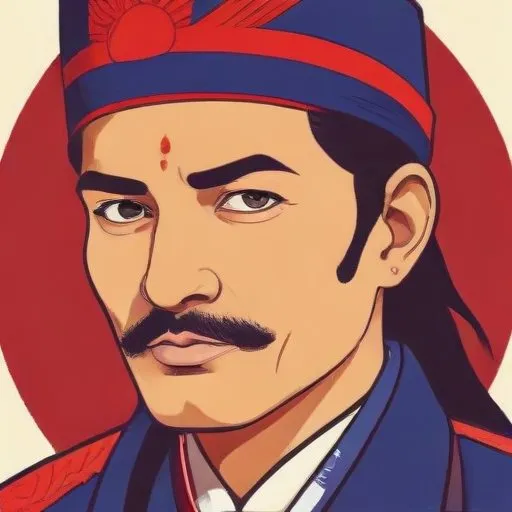
The last monarch of the Nepalese monarchy, who ruled from 1972 to 2001 and introduced a multiparty democracy, ending centuries of absolute monarchy. He's also known for his efforts to modernize and develop Nepal.
Birendra Bir Bikram Shah Dev, the tenth King of Nepal, ruled the country from 1972 until his assassination in 2001, leaving behind a legacy of contrasts - a monarch who was both revered and reviled, progressive and autocratic, modern and traditional.
Born on December 28, 1945, at the Narayanhiti Royal Palace in Kathmandu, Birendra was the eldest son of King Mahendra and Crown Princess Indra Rajya Lakshmi Devi. His early years were marked by privilege, with eight years of education at St. Joseph's School in Darjeeling, a prestigious Jesuit institution. This was followed by a stint at Eton College in the United Kingdom, where he honed his English skills and developed a taste for Western culture.
Upon his return to Nepal, Birendra embarked on a journey to explore the country, traveling to remote villages and living humbly among his subjects. This experience instilled in him a sense of duty to modernize Nepal, which he attempted to do by introducing democratic reforms and encouraging economic development. He also supported the arts, patronizing local craftsmen and artists, and even learning to fly helicopters.
Despite his progressive intentions, Birendra's reign was marked by controversy and turmoil. He faced opposition from democratic forces, who saw him as an obstacle to progress, and from Maoist insurgents, who sought to overthrow the monarchy altogether. His own family life was also marred by tragedy, with the murder of his son, Crown Prince Dipendra, in a royal massacre that remains shrouded in mystery to this day.
Birendra's reign was a complex tapestry of progress and regression, hope and despair. While he initiated reforms and encouraged economic development, he also faced criticism for his autocratic tendencies and failure to address the country's deep-rooted problems. His legacy remains a subject of debate, with some hailing him as a visionary and others condemning him as a relic of a bygone era.
Despite the controversies surrounding his reign, Birendra remains an important figure in Nepalese history, a symbol of a country's struggle to find its place in the modern world.
"I want to make Nepal a modern nation, but not a Western nation."
These words, spoken during a 1980s interview, reflect Birendra's vision for a Nepal that balanced tradition with progress, a delicate tightrope that he struggled to navigate throughout his reign.
Born in 1906
King who ruled Nepal from 1911 to 1955, playing a crucial role in the country's transition from a feudal to a modern state. He's known for his efforts to democratize Nepal and end the Rana dynasty's rule.
71 Years Old
The fourth king of Bhutan, who introduced democracy and modernized the country while prioritizing Gross National Happiness over economic growth. He's known for his unique approach to development and governance.
91 Years Old
King of Jordan from 1952 to 1999, known for his efforts to modernize and stabilize the country, as well as his role in Middle Eastern politics.
98 Years Old
The monarch who ruled Thailand for over 70 years, earning reverence for his humanitarian work, economic development, and cultural preservation. He was a unifying figure, stabilizing the country during turbulent times.
Born in 1922
The former King and Prime Minister of Cambodia who led the country to independence from France and later navigated its tumultuous politics, known for his charismatic leadership and diplomatic skills.
97 Years Old
The third king of Bhutan, who introduced modernization and democratization to the country, transforming it from a medieval society to a modern, constitutional monarchy. He's also known for his commitment to sustainable development and environmental conservation.
