


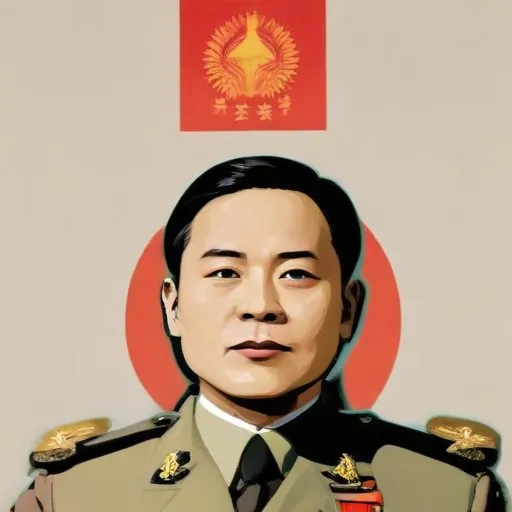
A prominent Chinese military leader and government official who played a crucial role in the country's early communist era, known for his contributions to the Chinese Civil War and subsequent national development.
Bo Yibo, a prominent Chinese politician, is renowned for his instrumental role in shaping China's economy during the 1980s and 1990s. As one of the most senior political figures of his time, Bo played a pivotal role in introducing economic liberalization, which paved the way for China's rapid growth and transformation into the global powerhouse it is today.
Bo Yibo was born on February 17, 1908, in Taiyuan, Shanxi Province, China. He joined the Chinese Communist Party (CCP) at the tender age of 17 and quickly rose through the ranks, becoming a Communist Party organizer in his native city. In 1928, he was promoted to organize Communist guerrilla movements in northern China, but his career was temporarily derailed when he was arrested and imprisoned by Kuomintang police in 1931.
In 1936, Bo signed an anti-communist confession, a move that secured his release from prison. This decision, although controversial, allowed him to return to Shanxi, rejoin the communists, and continue fighting against both the Kuomintang and the Japanese Empire in northern China.
After the Communists completed their unification of mainland China in 1949, Bo's career took off. He held successive posts as Communist China's inaugural Minister of Finance, a member of the Communist Party's Politburo, Vice Premier, chairman of the State Economic Commission, and vice chairman of the party's Central Advisory Commission.
In 1966, Bo was purged by the Mao-backed Gang of Four, but his fortunes changed with Mao's death in 1976. Deng Xiaoping, who rose to power in the late 1970s, brought Bo back into the political fold, recognizing his immense value to the party.
Bo was part of an elite group of powerful veterans, informally known as the Eight Immortals, who wielded significant influence during the 1980s and 1990s. This group, centered around Deng Xiaoping, played a crucial role in shaping China's economic and political trajectory.
Bo was a moderate conservative who supported economic liberalization, but initially maintained a cautious approach to political reforms. He initially backed both Hu Yaobang and the 1989 Tiananmen protesters, but eventually sided with hardliners, supporting Hu's dismissal in 1987 and the use of violence against protesters in 1989.
Bo's political influence began to wane in the 1990s, but he continued to use his clout to support both Deng Xiaoping and Jiang Zemin, as well as promote the career of his son, Bo Xilai. Bo Yibo passed away on January 15, 2007, leaving behind a legacy as one of the architects of modern China's economy.
Bo Yibo's life and career are a testament to the complexities of China's tumultuous 20th century. His legacy serves as a reminder of the country's remarkable transformation from a poor, agrarian society to a global economic powerhouse. Bo's contributions to China's economic liberalization have had a lasting impact on the country's development, making him an integral part of modern Chinese history.
Born in 1893
Leader of the Chinese Communist Party who implemented radical social and economic reforms, including the Great Leap Forward and the Cultural Revolution, shaping modern China's politics and economy.
Born in 1898
The first Premier of the People's Republic of China, serving from 1949 until his death in 1976, is most known for his key role in the Chinese Communist Party and his diplomatic efforts to improve relations with the West. He played a crucial part in shaping China's foreign policy and economy during a pivotal period in the country's history.
Born in 1904
A Chinese revolutionary and statesman who led the country's economic reforms, transforming it into a global superpower. He's credited with opening up China to the world and introducing capitalist principles.
73 Years Old
A renowned Chinese violinist and composer, blending Eastern and Western musical styles, creating a unique sound that showcases cultural fusion.
Born in 1898
A prominent military leader who played a crucial role in the Chinese Civil War and later became a key figure in the Communist Party, known for his criticisms of Mao's policies. He was eventually purged and persecuted during the Cultural Revolution.
Born in 1896
A prominent Chinese military leader and politician who played a key role in the Chinese Civil War and later served as the 1st Vice Premier of the People's Republic of China, known for his efforts in modernizing the Chinese military. He was a close ally of Mao Zedong and helped establish the People's Liberation Army.
