


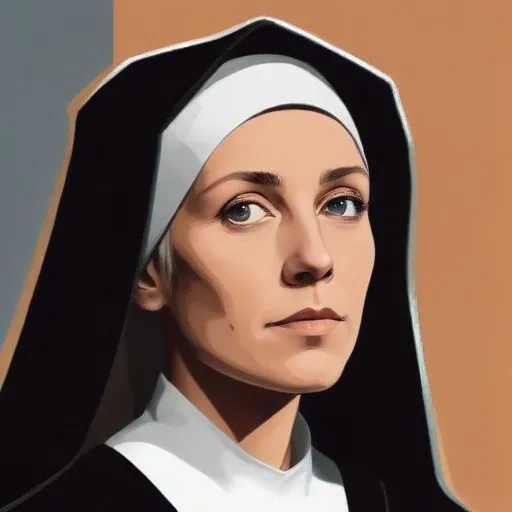
A 15th-century nun who entered a convent at a young age and lived a life of piety, leaving behind a legacy of spiritual writings and devotion. She's most known for her mystical visions and writings that inspired many.
Bridget of York, the seventh daughter of King Edward IV and his queen consort Elizabeth Woodville, is best known for her tumultuous early life and her eventual decision to dedicate herself to a life of devotion as a nun. Born on November 10, 1480, Bridget's life was marked by uncertainty and upheaval, yet she would find solace in the quiet confines of Dartford Priory.
Following the death of her father and the usurpation of the throne by Richard III, Bridget's life was turned upside down. At just two years old, she was declared illegitimate along with her siblings, and her mother, Elizabeth Woodville, feared for their safety. In an effort to protect her children, Elizabeth moved them to Westminster Abbey, where they received asylum and spent about a year.

After Richard III's demise, Henry Tudor took the throne and canceled the act declaring the children of Edward IV as bastards. Bridget's eldest sister, Elizabeth, would go on to marry Henry VII, solidifying the Tudor dynasty.
As Bridget grew older, she began to feel a strong inclination towards a life of devotion. Despite being considered as a potential bride for a Scottish prince, Bridget ultimately chose to dedicate herself to God, entering Dartford Priory in Kent. It was a decision that would bring her peace and tranquility, far removed from the turmoil of her early life.

As a nun, Bridget would lead a simple life, keeping in touch with her sister, Queen Elizabeth, who would provide for her petty expenses. Bridget would leave the priory only once, to attend her mother's funeral.
Bridget of York's life may have been marked by uncertainty, but her decision to dedicate herself to a life of devotion would come to define her. She would live out her days in peace, surrounded by the sisters of Dartford Priory, and would eventually be buried within the priory's walls.
Though often overlooked in the annals of history, Bridget's story serves as a testament to the strength and resilience of women in the face of adversity. Her legacy may not be as well-known as that of her siblings, but it is no less remarkable, a shining example of devotion and dedication.
Born in 1466
Daughter of King Edward IV, she married Henry VII, uniting the Houses of York and Lancaster, and was the mother of Henry VIII, establishing the Tudor dynasty.
Born in 1284
The king whose disastrous reign led to his eventual deposition and mysterious death, remembered for his alleged homosexual relationships and power struggles with nobles.
Born in 1367
The last king of the House of Plantagenet, deposed in a coup, known for his extravagance and tyranny, leading to his downfall and the rise of the Lancastrian dynasty.
Born in 1133
King of England from 1154 to 1189, known for establishing a strong centralized government, reforming the English church, and his tumultuous relationships with Thomas Becket and his sons.
Born in 1341
A powerful nobleman who played a key role in the Percy family's rebellions against King Henry IV, leading to the Battle of Shrewsbury. He was a skilled military leader and politician.
Born in 1408
A prominent nobleman and Lancastrian leader during the Wars of the Roses, he played a crucial role in the Battle of Barnet and was a key figure in the struggle for the English throne.
