


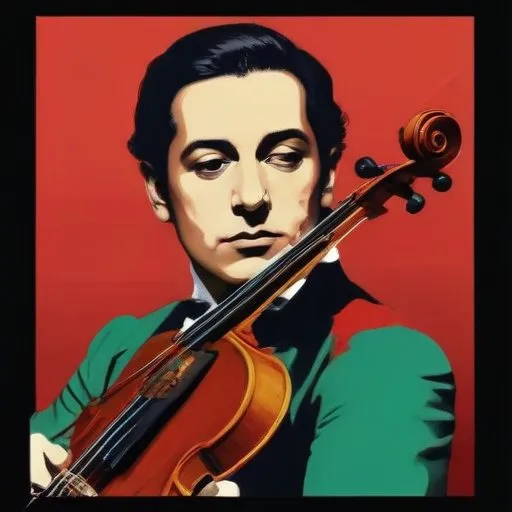
A 19th-century virtuoso violinist and composer, renowned for his exceptional technique and expressive playing style, leaving a lasting impact on the development of violin music.
Camillo Sivori was an Italian virtuoso violinist and composer, renowned for being the only known pupil of the legendary Niccolò Paganini. He was celebrated for his impeccable technique, agility, and musicianship, which earned him the reputation as one of the greatest violinists of the 19th century.
Sivori's musical journey began under the guidance of Paganini, from whom he learned the intricacies of violin playing. He also studied with Antonio Restano, Giacomo Costa, and Agostino Dellepiane, further honing his skills. This exceptional training laid the foundation for his remarkable career as a travelling virtuoso.
From 1827 to 1864, Sivori embarked on an uninterrupted journey, performing in numerous concerts across Europe and the Americas. One of his notable performances was at the Howard Athenaeum in Boston, where he mesmerized audiences with his renditions of "Il Campanello" and "Carnival of Venice".
Sivori collaborated with prominent composers of his time, including Giuseppe Verdi and Franz Liszt. He was particularly known for his interpretations of Verdi's works, and the composer himself praised Sivori's performances for their impeccable technique and musicianship. Sivori also premiered Luigi Cherubini's Requiem in E minor, demonstrating his versatility as a violinist.
Sivori was a connoisseur of fine instruments, owning violins crafted by masters such as Amati, Antonio Stradivari, Carlo Bergonzi, Gaetano Chiocchi, and Jean-Baptiste Vuillaume. His favorite instrument was the Vuillaume violin, a gift from Paganini, which he considered an impeccably close copy of the maestro's famous Cannone.
Sivori's unique ability to create lively, almost cinematographic effects with his violin playing immortalized Paganini's art and unique operatic interpretations. He was the only violinist of his time who could preserve Paganini's legacy, as the school of violin playing was rapidly changing and Paganini's art was being forgotten.
Sivori spent many years in Paris before returning to his hometown of Genoa, where he passed away on February 19, 1894. Throughout his life, he remained dedicated to his craft, leaving behind a legacy as one of the greatest violinists in history.
Born in 1782
A virtuosic violinist and composer who revolutionized the instrument's technical possibilities, leaving an indelible mark on classical music.
Born in 1692
A virtuosic violinist and composer who wrote over 150 concertos and sonatas, known for his technically demanding and expressive works that showcased his mastery of the instrument.
Born in 1678
A virtuosic violinist and prolific composer, he crafted over 400 concertos, including "The Four Seasons," which remains a beloved and iconic masterpiece of classical music.
Born in 1653
A virtuosic violinist and composer who revolutionized the concerto grosso form, creating a new era of classical music. His influential works elevated the violin to a solo instrument, shaping the course of Western classical music.
Born in 1755
A virtuosic violinist and prolific composer, he wrote over 30 violin concertos and influenced the development of the classical violin concerto. His music is still performed and admired today.
Born in 1784
A renowned 19th-century musician, he was a master violinist, prolific composer, and influential conductor, leaving a lasting legacy in classical music. His compositions and conducting style paved the way for future generations of musicians.
