


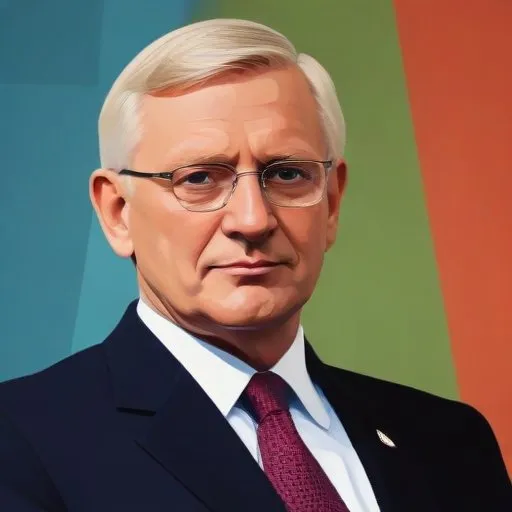
Served as Prime Minister of Sweden from 1991 to 1994, known for his efforts to reform the Swedish economy and his role in international diplomacy. Led the country's accession to the European Union.
Carl Bildt is a renowned Swedish politician and diplomat who has left an indelible mark on global politics. As the Prime Minister of Sweden from 1991 to 1994, he navigated the country through a tumultuous period of economic reform and European integration, earning him recognition as a visionary leader.
Bildt hails from a noble family with a rich tradition of public service. His great-great-grandfather, Baron Gillis Bildt, was the Prime Minister of Sweden from 1888 to 1889, setting the stage for Carl's future endeavors.
Bildt's political career began in 1979, when he entered the Riksdag, the Swedish parliament. He quickly rose through the ranks, becoming the leader of the Moderate Party in 1986, a position he held until 1999. During this period, he contested four general elections, solidifying his reputation as a formidable politician.
Bildt's true calling, however, lay in international diplomacy. He played a pivotal role in brokering peace in the Balkans, serving as the European Union's Special Envoy to the Former Yugoslavia from 1995 to 1997. His efforts culminated in the Dayton Peace Conference, which brought an end to the Bosnian War.
In the following years, Bildt continued to leave his mark on global politics, serving as the United Nations Secretary-General's Special Envoy for the Balkans from 1999 to 2001. His expertise in conflict resolution and international cooperation earned him a reputation as a trusted mediator.
Bildt was born on July 15, 1949, in Halmstad, Halland, Sweden. He is married to Mia Bohman, daughter of former Moderate Party leader and Minister of Economy, Gösta Bohman. His brother, Nils, was born in 1952.
Carl Bildt's illustrious career has left a lasting impact on global politics, diplomacy, and international cooperation. As a statesman, he has demonstrated unwavering dedication to conflict resolution and peace building. His legacy serves as a testament to the power of visionary leadership and the importance of international cooperation in shaping a better future.
In an era marked by growing global challenges, Bildt's work remains a beacon of hope, inspiring future generations of leaders to strive for peace, prosperity, and cooperation.
95 Years Old
The last leader of the Soviet Union, who introduced reforms that led to the end of the Cold War and the collapse of communism, earning a Nobel Peace Prize. He's known for his policies of glasnost and perestroika, which transformed the Soviet Union and the world.
Born in 1925
The first female Prime Minister of the United Kingdom, serving from 1979 to 1990, known for her conservative policies and leadership during the Falklands War.
Born in 1911
The charismatic leader who championed conservative policies, helped end the Cold War, and is often credited with restoring American pride and optimism. He's also remembered for his folksy, actor-honed communication style.
Born in 1924
The 41st President of the United States, a decorated war hero and skilled diplomat, led the country through the end of the Cold War and Gulf War. He's known for his foreign policy expertise and "kinder, gentler nation" vision.
96 Years Old
The first unified Germany's leader, who oversaw the country's reunification after the Berlin Wall's fall, and is credited with creating a strong, stable economy.
Born in 1916
A French lawyer and politician who served as the 21st President of France, known for his socialist policies and role in shaping the European Union. He's also remembered for his controversial past and complex personality.
83 Years Old
A former Prime Minister of the United Kingdom, he led the country from 1990 to 1997, playing a key role in shaping the nation's economy and foreign policy during a tumultuous period.
95 Years Old
First President of Russia, leading the country's transition from communism to democracy, and known for his bold reforms and iconic leadership style.
