


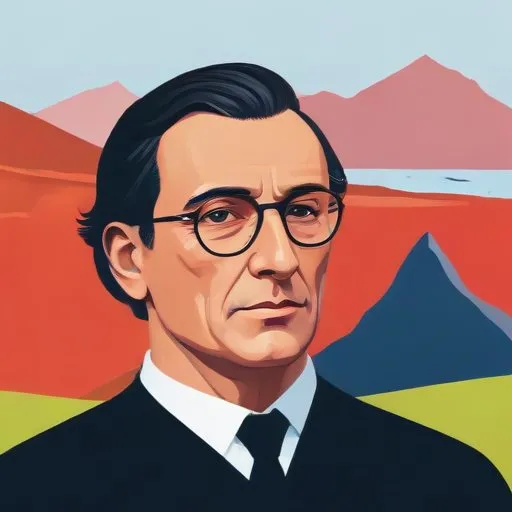
German lawyer and ornithologist who explored and documented the avifauna of the Faroe Islands, making significant contributions to the field of ornithology.
Carl Julian von Graba, a German lawyer and Royal Danish judicial councillor, is renowned for his groundbreaking ornithological research on the Faroe Islands, a remote and unexplored archipelago in the North Atlantic. His meticulous notes and specimen collections have contributed significantly to the field, earning him a mention in Charles Darwin's iconic book, "On the Origin of Species" (1872).
Born on February 17, 1799, in Itzehoe, Duchy of Holstein, von Graba was the son of a Danish cavalry colonel. He received his education at the prestigious Katharineum of Lbeck and later pursued law at Kiel University (1817). After completing his studies, von Graba worked as a lawyer in lower courts.
In 1828, von Graba embarked on a three-month voyage to the Faroe Islands, encouraged by his colleague and fellow ornithologist, Friedrich Boie. This pioneering expedition aimed to investigate the avifauna of the North in their natural habitats. During his journey, von Graba meticulously recorded his observations, collecting specimens and taking detailed notes on the local birdlife.
Von Graba's expedition took him to various islands of the Faroes, including Nlsoy, Sandoy, Suduroy, Eysturoy, and Streymoy. His careful observations and collections led to the discovery of new species, including the whitespeckled raven. His detailed descriptions of the birds he saw, including their weight, measurement, and plumage color, have become invaluable resources for modern ornithologists.
Von Graba's contributions to ornithology have had a lasting impact on the field. The local puffin he described was subsequently named Fratercula arctica grabae in his honor. His work has inspired future generations of researchers, and his discoveries have shed light on the unique avifauna of the Faroe Islands.
"The birds of the North in their home environment... would be even stranger than the birds of the Hebrides, Orkneys and Shetlands."
| 1799 | Born in Itzehoe, Duchy of Holstein |
| 1817 | Began studying law at Kiel University |
| 1828 | Embarked on a three-month voyage to the Faroe Islands |
| 1874 | Passed away on March 30th in Kiel |
Von Graba's pioneering work has left an indelible mark on the world of ornithology. His dedication to discovery and meticulous documentation have inspired generations of researchers, ensuring his legacy as a true pioneer in the field.
Born in 1729
A German pastor and botanist who traveled with Captain James Cook on his second voyage, discovering and documenting numerous plant species in the Pacific Islands. He's also known for his contributions to the field of ethnology.
Born in 1754
A pioneering ethnologist and journalist who traveled extensively, documenting indigenous cultures and advocating for social justice, leaving a lasting impact on our understanding of diverse societies.
Born in 1707
Developed the system of binomial nomenclature, which is still used today to classify and name living organisms. This system has had a profound impact on the fields of biology, ecology, and conservation.
Born in 1769
A pioneering geographer and explorer who mapped much of South America and discovered the Caspian Sea's connection to the Black Sea, greatly advancing our understanding of the natural world.
Born in 1741
A German zoologist and botanist who traveled extensively throughout Russia, discovering and describing numerous new species of plants and animals, and making significant contributions to the field of natural history.
Born in 1861
A Norwegian pioneer who explored the Arctic, made groundbreaking scientific discoveries, and championed humanitarian causes, earning a Nobel Prize for his efforts. He's most famous for being the first to cross Greenland and his innovative sled designs.
