


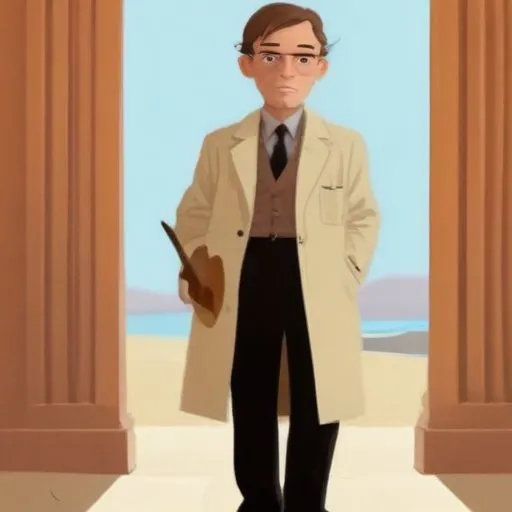
Italian micropalaeontologist renowned for his groundbreaking research on foraminifera, a group of tiny marine organisms, and their significance in understanding Earth's climate history.
Carlo Fornasini, an Italian micropalaeontologist, revolutionized the field of geology by developing the technique of biostratigraphy, which uses fossil foraminifera to sequence marine sedimentary deposits by their relative dates. His groundbreaking work in the late 19th century paved the way for a deeper understanding of the Earth's history and the formation of its crust.
Born on November 3, 1854, in Bologna, Italy, Carlo Fornasini was the third son of Francesco Fornasini, a medical doctor, and his wife Carlotta ne Ferraresi. He developed an interest in natural sciences at a young age and pursued his passion at the University of Bologna, where he studied under the guidance of Giovanni Capellini, a renowned geologist.
In 1877, Fornasini graduated with honors, submitting a thesis that argued from the sequence of the fossil record that certain chalks, marls, and clays in the Savena valley near Bologna dated from the Pliocene era (5.3-2.6 million years ago) rather than the Miocene era (23-5.3 million years ago), as previously thought. This discovery was a significant milestone in the field of geology, but it was unfortunately overshadowed by the actions of his mentor, Giovanni Capellini.
Capellini, who published a paper on Fornasini's discovery in 1877, relegated Fornasini's contribution to that of an assistant and passed off his conclusions as his own. This unethical behavior, though unacceptable by today's standards, was not uncommon in the scientific community at the time. Fornasini's work was undervalued, and he was deprived of the recognition he deserved.
After a four-year hiatus, Fornasini returned to palaeontology, possibly encouraged by his friend Lodovico Foresti, an assistant at the Museo Geologico in Bologna. In September and October 1881, he helped organize and attended the 2nd International Geological Congress, marking a significant turning point in his career.
Fornasini's pioneering work in micropalaeontology paved the way for future generations of geologists and palaeontologists. His technique of biostratigraphy is still widely used today, allowing scientists to reconstruct the Earth's history with greater accuracy. Fornasini's contributions to the field of geology have left a lasting impact, cementing his place as a pioneer in the field of micropalaeontology.
Born in 1885
Designed and flew airships, leading the first expedition to reach the North Pole by air in 1926. He also led a tragic expedition to the Arctic in 1928 that ended in disaster.
Born in 1872
First person to reach the South Pole, leading a Norwegian expedition in 1911, and a pioneer in Arctic and Antarctic exploration.
Born in 1868
Led a British expedition to the South Pole, racing against a Norwegian team, and tragically perished on the return journey. He is remembered for his bravery and sacrifice in the pursuit of scientific discovery.
Born in 1874
Led expeditions to the Antarctic, famously surviving a disastrous shipwreck and trekking to safety, earning a legendary reputation for bravery and leadership.
Born in 1861
A Norwegian pioneer who explored the Arctic, made groundbreaking scientific discoveries, and championed humanitarian causes, earning a Nobel Prize for his efforts. He's most famous for being the first to cross Greenland and his innovative sled designs.
