


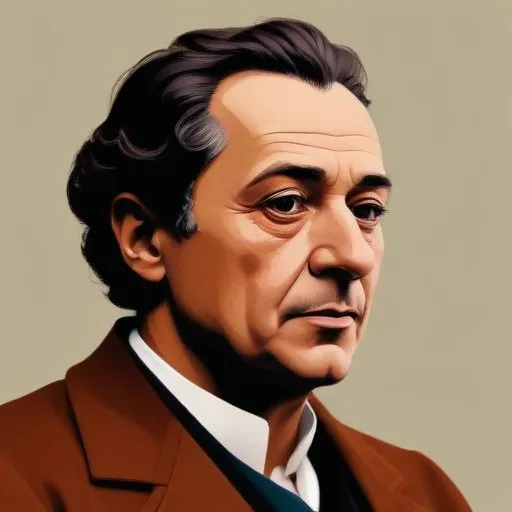
An 18th-century poet and academic who wrote lyrical and satirical works, known for his wit and clever use of language. He was a prominent figure in the Italian Enlightenment.
Carlo Innocenzo Frugoni was a renowned Italian poet and librettist of the 18th century, celebrated for his lyrical and pastoral works that embodied the essence of the Arcadian Academy. His poetry and writings were characterized by their elegance, facility, and fluency, earning him a reputation as one of the most skilled writers of his time.
Born on November 21, 1692, in Genoa, Italy, Frugoni was originally destined for the church, but his talents lay elsewhere. Against his will, he was shut up in a convent at the age of 15 and forced to make monastic vows the following year. However, his aversion to this life led him to pursue a different path.
Frugoni's talent for writing and poetry soon became apparent, and he began teaching rhetoric at various universities, including Brescia, Rome, Genoa, Bologna, and Modena. His brilliant fluency and eloquence attracted a large number of students, earning him a reputation as a distinguished professor and writer.
Through his connections with Cardinal Bentivoglio, Frugoni was recommended to Antonio Francesco Farnese, Duke of Parma, who appointed him his poet laureate. He remained at the court of Parma until the Duke's death, after which he returned to Genoa.
Frugoni's collected works were published in 10 volumes in 1799, followed by a more complete edition in 15 volumes the same year. His writings showcase his mastery of Latin and Italian prose and verse, with a focus on lyrical and pastoral poetry.
One of his notable works is the libretto for Tommaso Traetta's opera "Ippolito ed Aricia," which was inspired by Jean Racine's dramatic tragedy "Phèdre." Frugoni's correspondence with Francesco Algarotti during this period provides valuable insight into the creative process behind this opera.
Frugoni's impact on Italian literature is undeniable, and his pupils, including Marco Cappello, went on to become accomplished writers in their own right. His contributions to the Arcadian Academy helped shape the literary landscape of 18th-century Italy.
Today, Frugoni is remembered as a poet and librettist of great elegance and facility, whose works continue to inspire and delight readers and scholars alike.
Frugoni's life was marked by significant milestones, including his release from monastic vows and his subsequent recovery of a portion of his paternal inheritance. His later years were devoted to poetical composition, and he remained at the court of Parma until his death on December 20, 1768.
Through his life and works, Carlo Innocenzo Frugoni left an indelible mark on Italian literature, cementing his place as one of the most celebrated poets and librettists of the 18th century.
Born in 1304
A 14th-century Italian poet and scholar who pioneered the Renaissance humanist movement, revitalizing interest in classical Greek and Roman literature, and inspiring a new era of artistic and intellectual exploration.
Born in 1835
A renowned Italian poet and educator, known for his patriotic and lyrical works that explored themes of Italian identity and unity. He was the first Italian to receive the Nobel Prize in Literature.
Born in 1778
A leading figure of Italian Romanticism, known for his passionate and patriotic poetry, which often explored themes of love, beauty, and the struggle for Italian independence.
Born in 1888
An Egyptian-Italian soldier, journalist, and poet who explored the human condition through surreal and symbolic verse, influencing 20th-century modernist poetry. His work is a testament to the power of language in capturing the essence of war and existence.
