


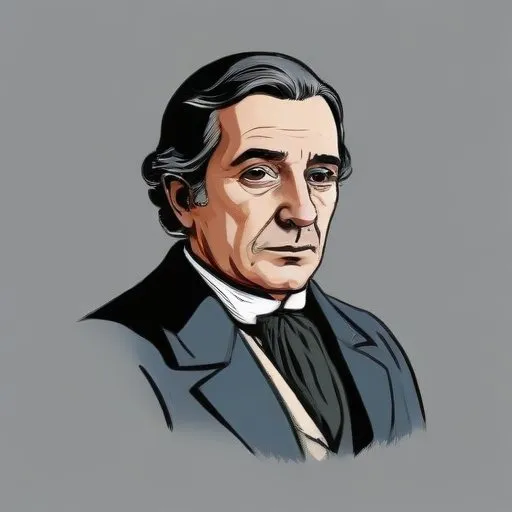
A French jurist and diplomat who played a key role in shaping international law and diplomacy in the 17th and 18th centuries, particularly in the development of the concept of sovereignty.
Charles Ancillon was a French jurist and diplomat who dedicated his life to fighting for the rights of Huguenots and leaving an indelible mark on education in Brandenburg-Prussia. He is renowned for his tireless efforts in establishing institutions that promoted learning and intellectual growth, most notably the Academy of Berlin, which he co-founded with Gottfried Leibniz.
Ancillon was born on July 28, 1659, in Metz, France, into a prominent family of Huguenots. His father, David Ancillon, was a pastor who was forced to flee France after the revocation of the Edict of Nantes in 1685. Charles pursued his studies in law at Marburg, Geneva, and Paris, where he was called to the bar.
Ancillon pleaded the cause of the Huguenots at the court of King Louis XIV, urging that Metz be exempted from the revocation of the Edict of Nantes. Although his efforts were unsuccessful, he continued to advocate for the rights of his community. In 1687, he joined his father in Berlin, where he was appointed juge et directeur de colonie de Berlin by Elector Frederick III.
Ancillon's passion for education led him to become the first headmaster of the Franzsisches Gymnasium Berlin. He also published several works on the revocation of the Edict of Nantes and its consequences. Although his literary style was considered stiff and cold, his personal character earned him the confidence of the elector.
In 1699, Ancillon succeeded Samuel Pufendorf as historiographer to the elector and replaced his uncle Joseph Ancillon as judge of all French refugees in the Margraviate of Brandenburg. He played a key role in the negotiations that led to the assumption of the title of King in Prussia by the elector. Ancillon's most valuable work is the Histoire de l'établissement des Français réfugiés dans les états de Brandebourg, published in Berlin in 1690.
Ancillon's philosophical contributions were deeply rooted in his Christian faith and his commitment to promoting education and intellectual freedom. He believed in the importance of fostering a culture of learning and critical thinking, which is reflected in his efforts to establish institutions that would provide opportunities for individuals to grow and develop.
Ancillon's legacy extends far beyond his own lifetime. The institutions he established, including the Academy of Berlin, have had a lasting impact on education in Germany and beyond. His commitment to promoting intellectual freedom and critical thinking continues to inspire generations of scholars and thinkers.
Ancillon's life and work are a testament to the struggles and triumphs of the Huguenot community in Europe during the 17th century. His legacy serves as a reminder of the importance of promoting education, intellectual freedom, and critical thinking in the face of adversity.
Born in 1694
A witty and insightful 18th-century writer and philosopher who used satire to critique societal norms and advocate for reason, tolerance, and human rights.
Born in 1712
A pioneering thinker who shaped modern democracy and education with his ideas on social contracts, general will, and the importance of early childhood education. His writings influenced the French Revolution and modern political thought.
Born in 1689
A French lawyer and philosopher who developed the concept of separation of powers, which divides a government into legislative, executive, and judicial branches to prevent abuse of power. His ideas greatly influenced modern democracy.
Born in 1717
A French Enlightenment thinker who made significant contributions to mathematics, physics, and philosophy, particularly in the fields of fluid dynamics and the study of vibrating strings. He's also known for his work on the Encyclopedia, a comprehensive reference work that aimed to compile all knowledge of the time.
Born in 1647
A 17th-century philosopher and writer who critiqued religious intolerance and advocated for reason, skepticism, and intellectual freedom. His works influenced the Enlightenment and modern critical thinking.
