


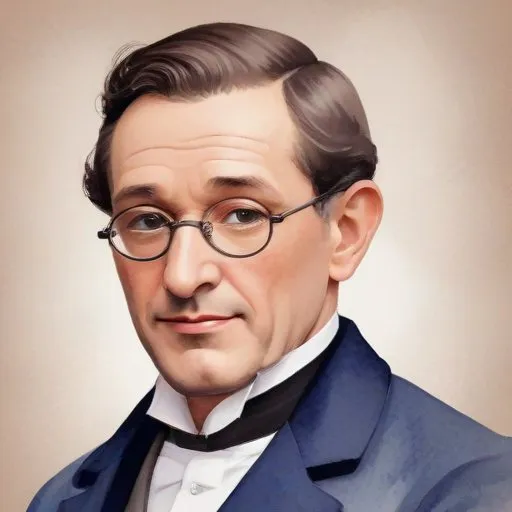
Developed new methods for synthesizing organic compounds, including the discovery of several new acids, and made significant contributions to the field of chemistry.
Charles Frédéric Gerhardt, a prominent French chemist, is renowned for his groundbreaking contributions to the field of organic chemistry, particularly in the classification and synthesis of organic compounds. His work laid the foundation for modern organic chemistry, earning him a revered position among the greatest chemists of his time.
Born on August 21, 1816, in Strasbourg, Alsace, Gerhardt attended the local gymnasium before pursuing higher education at the Karlsruhe Institute of Technology. It was during this period that he developed an interest in chemistry, inspired by the lectures of Friedrich Wöhler.
Gerhardt's fascination with chemistry further grew under the guidance of Otto Linné Erdmann at the school of commerce in Leipzig. He later honed his skills at the University of Giessen, where he worked and studied under the tutelage of Justus von Liebig, a renowned German chemist.
In 1841, Gerhardt was appointed as a chemistry professor at the Montpellier faculty of sciences, a position he held until his untimely death in 1856. During his tenure, he published his seminal work, Précis de chimie organique (1844-1845), which presented a systematic classification of organic compounds.
Gerhardt's most notable contribution was the development of a new system of organic chemistry, which emphasized the importance of molecular structure and chemical reactions. He also made significant discoveries in the synthesis of organic compounds, including the production of tartaric acid and the identification of cymene.
Gerhardt was an exceptional teacher, known for his engaging lectures and ability to inspire his students. He mentored several prominent chemists, including Antoine-François Boutron-Charlard and Charles Adolphe Wurtz.
Gerhardt's work had a profound impact on the development of modern organic chemistry. His classification system and synthesis methods paved the way for future generations of chemists, including Friedrich August Kekulé and Aleksandr Butlerov.
Gerhardt's life was marked by personal struggles, including a tumultuous relationship with his father, who opposed his decision to pursue a career in chemistry. He also clashed with his colleagues, including Jean Baptiste Dumas, over matters of scientific opinion.
Despite these challenges, Gerhardt remained dedicated to his work, and his contributions continue to influence the field of organic chemistry to this day.
Gerhardt's work on organic chemistry has had a lasting impact on modern society, from the development of pharmaceuticals to the production of plastics and polymers. His contributions continue to inspire new generations of scientists and researchers.
Through his pioneering work, Charles Frédéric Gerhardt left an indelible mark on the field of organic chemistry, cementing his place as one of the most important chemists of the 19th century.
Born in 1822
Developed vaccines for rabies and anthrax, and pioneered the germ theory of disease, revolutionizing our understanding of microbiology and disease prevention.
Born in 1827
A pioneer in organic chemistry, he discovered the synthesis of organic compounds from inorganic substances, revolutionizing the field and earning a Nobel Prize in Chemistry.
Born in 1852
Discovered the element fluorine and developed an electric arc furnace, earning a Nobel Prize in Chemistry in 1906.
Born in 1779
Developed the modern system of chemical notation and discovered several elements, including silicon and selenium. He's considered the father of Swedish chemistry.
Born in 1743
Father of modern chemistry, discovered oxygen, and developed a systematic method of chemical nomenclature. He laid the foundation for modern chemistry and paved the way for future scientific discoveries.
Born in 1778
Pioneering chemist and physicist who discovered several elements, including potassium and sodium, and invented the Davy lamp, a safety lamp for miners. His groundbreaking work laid the foundation for modern chemistry and electrochemistry.
