


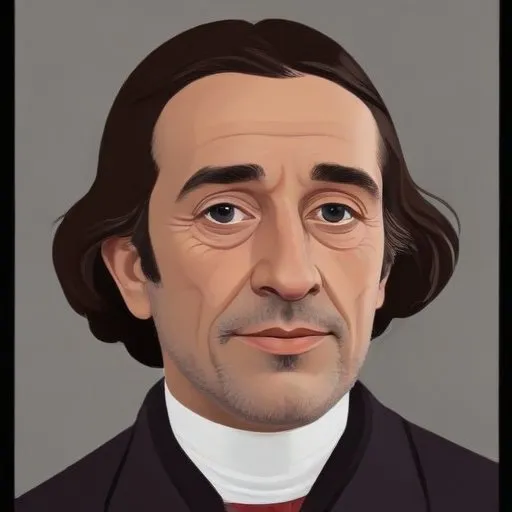
French philosopher and author who advocated for perpetual peace and proposed a union of European states to prevent war, influencing modern international relations and global governance.
Known for his groundbreaking proposal of an international organization to maintain peace, CharlesIrne Castel de SaintPierre was a French author who dared to think beyond his time. His idea, although novel in the 18th century, has become a cornerstone of modern international relations.
Born on February 18, 1658, at the Château of SaintPierreglise near Cherbourg, SaintPierre was the youngest of five children to the Marquis de SaintPierre, the grand bailli of Cotentin. His poor health made him unsuitable for a military career, leading him to pursue a life in the priesthood.
SaintPierre was educated by the Jesuits, and his family connections introduced him to the salons of Madame de la Fayette and the Marquise de Lambert in Paris. These formative experiences shaped his intellectual curiosity and laid the foundation for his future work.
In 1695, SaintPierre was elected to the Académie Française, despite not having produced any notable work at the time. This election was a significant episode in the Quarrel of the Ancients and the Moderns, with SaintPierre being a clear representative of the latter. The same year, he became chaplain to Madame, the king's sister-in-law, securing a foothold at court.
SaintPierre worked tirelessly on his project of universal peace from 1708, publishing early versions from 1712. His ideas were revolutionary for the time, proposing an international organization to maintain peace and prevent war. Although he developed this concept before working as a negotiator of the Treaty of Utrecht (1712-1713), it was only later that he published his most comprehensive work on the subject.
In 1718, SaintPierre published Discours sur la polysynodie, where he proposed that appointed ministers be replaced by elected councils. This work was a scathing critique of the policy of Louis XIV, which led to his expulsion from the Académie Française in 1718.
In 1723, SaintPierre co-founded the Club de l'Entresol, an early modern think tank in Paris, with PierreJoseph Alary. Although the club was closed for political reasons in 1731, it played a significant role in shaping SaintPierre's ideas and influencing future thinkers. SaintPierre passed away on April 29, 1743, at the age of 85, leaving behind a legacy of visionary ideas that continue to inspire international cooperation and peace efforts.
SaintPierre's work has had a lasting impact on modern society, influencing prominent thinkers such as Rousseau and Kant. His ideas on international cooperation and peace have become cornerstones of modern international relations, shaping global politics and inspiring generations of diplomats and policymakers.
SaintPierre's remarkable life and work serve as a testament to the power of visionary thinking and the importance of striving for international cooperation and peace.
Born in 1694
A witty and insightful 18th-century writer and philosopher who used satire to critique societal norms and advocate for reason, tolerance, and human rights.
Born in 1712
A pioneering thinker who shaped modern democracy and education with his ideas on social contracts, general will, and the importance of early childhood education. His writings influenced the French Revolution and modern political thought.
Born in 1689
A French lawyer and philosopher who developed the concept of separation of powers, which divides a government into legislative, executive, and judicial branches to prevent abuse of power. His ideas greatly influenced modern democracy.
Born in 1717
A French Enlightenment thinker who made significant contributions to mathematics, physics, and philosophy, particularly in the fields of fluid dynamics and the study of vibrating strings. He's also known for his work on the Encyclopedia, a comprehensive reference work that aimed to compile all knowledge of the time.
Born in 1647
A 17th-century philosopher and writer who critiqued religious intolerance and advocated for reason, skepticism, and intellectual freedom. His works influenced the Enlightenment and modern critical thinking.
Born in 1715
A French Enlightenment philosopher who argued that human beings are motivated solely by self-interest and that morality is based on the pursuit of pleasure and avoidance of pain. His ideas influenced the development of utilitarianism and the concept of the social contract.
