


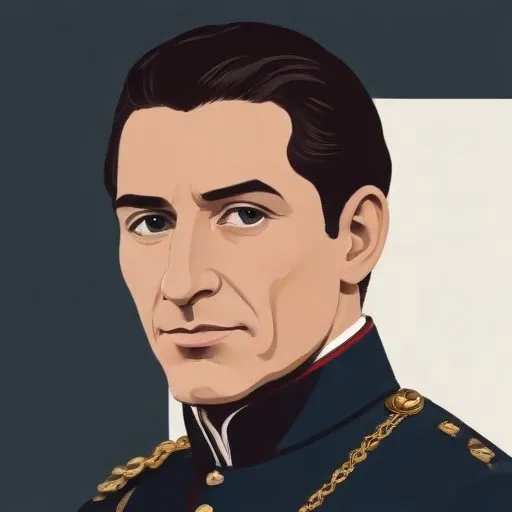
Heir to the thrones of Navarre and Aragon, known for his poetry and literary works, which showcased his humanist and Renaissance ideals.
Charles, Prince of Viana, also known as Charles IV of Navarre, was the son of King John II of Aragon and Queen Blanche I of Navarre, and the rightful heir to the throne of Navarre. He is best known for his tumultuous relationship with his father, his multiple marriages, and his struggles to assert his claim to the throne.
Born on May 29, 1421, Charles was the grandson of Charles III, King of Navarre, and was bequeathed the kingdom of Navarre by his mother and grandfather. However, when his mother, Blanche I, died in 1441, his father, King John II, seized the kingdom, excluding Charles from his rightful inheritance. This move sparked a succession crisis that would last for decades.
Charles married Agnes of Cleves in 1439, but the marriage was childless and ended with Agnes' death in 1448. He then took a mistress, Brianda de Vaca, with whom he had an illegitimate son. After Agnes' death, Charles attempted to remarry, but his plans were thwarted by his father and other European monarchs. He eventually had three illegitimate children with three different mistresses: Anna, Countess of Medinaceli; Philip, Archbishop of Palermo; and John, Bishop of Huesca.
The strained relationship between Charles and his father, King John II, worsened when John took Juana Enriquez as his second wife in 1447. Juana soon bore him a son, Ferdinand II of Aragon, who would eventually become a major rival to Charles' claim to the throne. The tension between father and son continued to escalate, with Charles seeking to assert his rights to the throne and his father seeking to consolidate his power.
Charles, Prince of Viana, died on September 23, 1461, without ever securing his claim to the throne. Despite his tumultuous life, Charles left a lasting legacy in the history of Navarre and the Iberian Peninsula. His struggles and conflicts with his father and other European monarchs shaped the course of history, and his story continues to fascinate historians and scholars to this day.
Charles, Prince of Viana, lived during a time of great turmoil and change in Europe. His life and struggles were shaped by the complexities of medieval politics, the rivalries between European monarchies, and the shifting power dynamics of the Iberian Peninsula. Despite his failures and setbacks, Charles' story remains an important part of the history of Navarre and the legacy of the royal families of Europe.
Born in 1380
Unified the Crown of Aragon, ruling over a vast territory in eastern Spain, and sponsored the voyages of Christopher Columbus, leading to the discovery of the New World.
Born in 1451
Unified the Spanish kingdoms, sponsored Christopher Columbus's voyage to the Americas, and established the Spanish Inquisition.
Born in 1350
King of Aragon from 1387 to 1396, known for his tumultuous reign marked by conflicts with the nobility and the papacy. He was also a patron of the arts and literature.
Born in 1478
The King of Castile and ruler of Burgundy, known for his lavish spending and cultural achievements, including the construction of the Palace of Coudenberg in Brussels.
Born in 1500
Ruling over a vast empire from 1519 to 1556, he was a powerful and influential leader who played a crucial role in shaping European politics and religion. He is most known for his efforts to unify Christian Europe and defend it against the Ottoman Empire.
Born in 1503
The first Habsburg to rule the Holy Roman Empire, he unified Austria and introduced the concept of a hereditary monarchy, shaping European politics for centuries to come.
Born in 1830
Queen of Spain from 1833 to 1868, known for her tumultuous reign marked by political instability, corruption, and social unrest. She was eventually exiled to France after a revolution.
Born in 1886
The last Bourbon king of Spain, ruling from 1886 to 1931, known for his tumultuous reign marked by political instability, economic struggles, and the loss of Spain's last colonies.
