


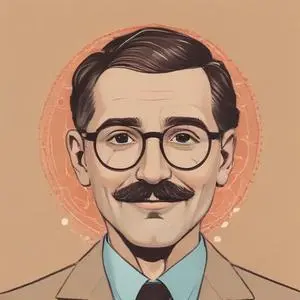
Developed groundbreaking theories on alternating current (AC) systems, revolutionizing the field of electrical engineering. His work enabled efficient transmission of power over long distances, transforming the way electricity is distributed globally.
Charles Proteus Steinmetz, a trailblazing mathematician and electrical engineer, is renowned for fostering the development of alternating current (AC) systems, revolutionizing the electric power industry in the United States. His groundbreaking mathematical theories and innovative designs enabled the widespread adoption of AC power, earning him the nickname "The Forger of Thunderbolts."
Born Karl August Rudolph Steinmetz on April 9, 1865, in Breslau, Province of Silesia, Prussia (now Wrocław, Poland), Steinmetz was the son of Caroline Neubert and Karl Heinrich Steinmetz. Despite being afflicted with dwarfism, hunchback, and hip dysplasia, Steinmetz graduated with honors from St. John's Gymnasium in 1882 and went on to study at the University of Breslau.
Nearing completion of his doctorate in 1888, Steinmetz was forced to flee to Zürich, Switzerland, to escape prosecution by the German government for his socialist activities. This pivotal moment marked the beginning of his journey to the United States, where he would make his mark on the electrical engineering community.
Steinmetz's work at General Electric (GE) in Schenectady, New York, led to numerous breakthroughs, including his formulation of the law of hysteresis, which enabled engineers to design more efficient electromagnetic apparatus. He also developed the concept of the "Steinmetz equivalent circuit," a fundamental tool in electrical engineering. At the time of his death, Steinmetz held an astonishing 200 patents.
Steinmetz's immense contributions to the field of electrical engineering earned him numerous accolades, including the IEEE Charles Proteus Steinmetz Award, one of the highest technical recognitions given by the Institute of Electrical and Electronics Engineers. His legacy inspired the creation of the Steinmetz Memorial Lecture, which continues to recognize outstanding contributions to electrical engineering.
Steinmetz's pioneering work in AC systems paved the way for the widespread electrification of American homes and industries. His innovations have had a lasting impact on modern society, enabling the efficient and reliable transmission of electrical power.
In recognition of his immense contributions, Steinmetz's name is commemorated in various honors and scholarships, including the Steinmetz Memorial Scholarship and the Steinmetz Award. His legacy continues to inspire generations of electrical engineers and mathematicians.
Charles Proteus Steinmetz, a true visionary and trailblazer, left an indelible mark on the world of electrical engineering. His groundbreaking work and innovative spirit continue to inspire and shape the course of modern technology.
Born in 1846
Developed innovative braking systems for trains, revolutionizing rail safety and transforming the industry. Founded a company that dominated the market for over a century.
Born in 1856
A pioneering engineer who harnessed the power of alternating current (AC) to transform the world's electrical systems, and is credited with developing groundbreaking technologies like radio communication and X-ray imaging.
Born in 1847
A pioneer in innovation, credited with developing groundbreaking inventions that revolutionized the way people live and communicate, including the light bulb and phonograph.
Born in 1791
Pioneering scientist who discovered electromagnetic induction, formulated the laws of electrolysis, and invented the first electrical generator, revolutionizing our understanding of electricity and its applications.
Born in 1831
Developed groundbreaking theories that unified electricity and magnetism, and predicted the existence of radio waves, revolutionizing our understanding of the physical world.
Born in 1857
A pioneer in the field of electromagnetism, he discovered radio waves and proved James Clerk Maxwell's theories, paving the way for modern wireless communication. His experiments led to the development of radio, television, and mobile phones.
Born in 1853
Developed groundbreaking inventions and innovations in electrical engineering, including the first practical welding machine and the first electric streetcar system.
Born in 1847
A Scottish-American engineer and academic credited with inventing the telephone, revolutionizing real-time communication. This innovation transformed the way people connect and conduct business.
