


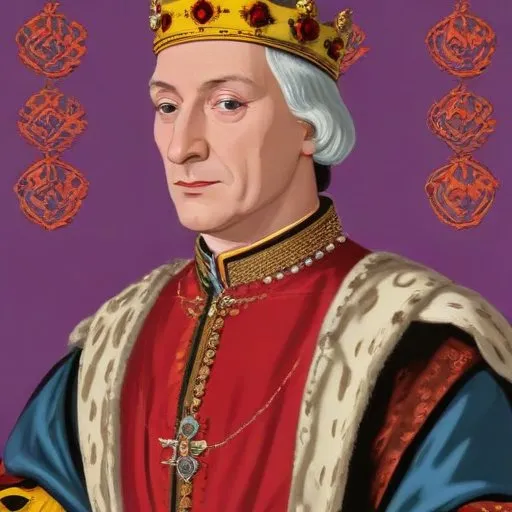
The King of Bavaria who briefly held the title of Holy Roman Emperor, known for his attempts to reform the empire and his role in the War of the Austrian Succession.
Charles VII, Holy Roman Emperor, is best known for his brief but significant reign as the Prince-Elector of Bavaria and as the Holy Roman Emperor from 1742 to 1745. During his short time in power, he managed to break the three-century-long Habsburg dominance of the imperial throne, marking a significant shift in European politics.
Born on August 6, 1697, in Brussels, Charles was the eldest son of Maximilian II Emanuel, Elector of Bavaria, and the Polish princess Theresa Kunegunda Sobieska. His family was embroiled in the complexities of European politics, and Charles' early life was marked by turmoil and upheaval.
Charles' fortunes began to change when he married Archduchess Maria Amalia of Austria, daughter of Holy Roman Emperor Joseph I, in 1722. This strategic marriage alliance strengthened his claim to the imperial throne and paved the way for his future success.
In 1726, Charles became the Prince-Elector of Bavaria following the death of his father. Over the next decade, he consolidated his power and resources, positioning himself for a bid for the imperial throne.
In 1740, Charles VI, the Holy Roman Emperor, died, and Charles claimed the Archduchy of Austria and briefly gained control of the Bohemian throne. In 1742, he was elected Holy Roman Emperor, marking the end of three centuries of uninterrupted Habsburg rule.
Although his reign was cut short by his death in 1745, Charles VII left a lasting impact on European politics. His brief time in power saw significant changes, including the rise of Prussia and the decline of Habsburg influence.
Charles VII's legacy is complex and multifaceted. While his reign was marked by controversy and power struggles, he also oversaw significant cultural and artistic developments in Bavaria.
His reign marked a turning point in European history, paving the way for the rise of new powers and the decline of the old order. Today, Charles VII is remembered as a shrewd politician and a cunning strategist who left an indelible mark on the course of European history.
Charles married Archduchess Maria Amalia of Austria and had seven children with her. His family life was marked by turmoil and tragedy, with several of his children dying in infancy or early childhood.
Despite the challenges he faced, Charles remained dedicated to his family and his duties as a ruler. His personal life serves as a testament to the complexities and challenges faced by European monarchs during the 18th century.
Despite his brief reign, Charles VII left a lasting impact on European history. His legacy serves as a testament to the complexities and challenges of 18th-century politics, and his life continues to fascinate historians and scholars today.
Born in 1338
The King of France from 1364 to 1380, known for his military victories and rebuilding of Paris, earning him the nickname "Charles the Wise".
Born in 1415
The last of the Habsburg emperors, he ruled the Holy Roman Empire from 1452 to 1493, known for his efforts to reform the empire and strengthen its central authority.
Born in 1768
The last Holy Roman Emperor, who ruled from 1792 to 1806, oversaw the dissolution of the Holy Roman Empire and was a key figure in European politics during the Napoleonic Wars.
Born in 1503
The first Habsburg to rule the Holy Roman Empire, he unified Austria and introduced the concept of a hereditary monarchy, shaping European politics for centuries to come.
Born in 1459
First Holy Roman Emperor to rule simultaneously as King of the Romans and King of Spain, known for uniting fragmented German states and establishing the Habsburg dynasty.
Born in 1747
The last Habsburg ruler to hold the title of Holy Roman Emperor, he oversaw the dissolution of the empire and played a key role in European politics during the French Revolution.
Born in 1741
Reformer of the Habsburg dominions, abolishing serfdom and promoting religious tolerance, who implemented numerous reforms to modernize his empire.
Born in 1768
The last Holy Roman Emperor, who ruled from 1792 to 1806, oversaw the dissolution of the Holy Roman Empire and was a key figure in European politics during the Napoleonic Wars.
