


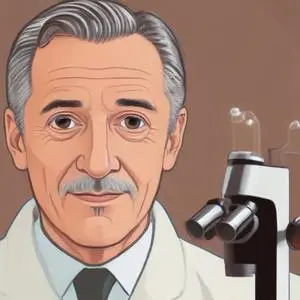
A Nobel Prize-winning scientist who discovered and characterized lysosomes, the cell's recycling centers, and made significant contributions to our understanding of cellular biology. His work has far-reaching implications for medicine and our understanding of life processes.
Christian René Marie Joseph, Viscount de Duve, was a Belgian cytologist and biochemist who made groundbreaking discoveries in the field of cellular biology, earning him the Nobel Prize in Physiology or Medicine in 1974. His serendipitous findings of peroxisomes and lysosomes revolutionized our understanding of cellular structures and functions, paving the way for significant advances in the fields of medicine and biology.
Born on October 2, 1917, in Thames Ditton, Surrey, England, de Duve was the son of Belgian refugees who returned to Belgium in 1920. He received his education from the Jesuits at Our Lady College, Antwerp, and later studied medicine at the Catholic University of Leuven. De Duve earned his MD in 1941 and went on to earn the highest university degree, agrégation de l'enseignement supérieur, equivalent to a PhD, in 1945.
De Duve's research career spanned several decades and took him to various institutions, including the Karolinska Institutet in Stockholm and the Washington University in St. Louis. He joined the faculty of medicine at Leuven in 1947 and later became a professor at the Rockefeller University in New York in 1962. In 1974, the same year he received his Nobel Prize, de Duve founded the International Institute of Cellular and Molecular Pathology, which would later be renamed the de Duve Institute.
De Duve's most significant contributions to science include the discovery of peroxisomes and lysosomes, two types of cellular organelles that play crucial roles in cellular metabolism and waste management. He also coined the terms "autophagy," "endocytosis," and "exocytosis" to describe the processes of cellular self-digestion, cellular uptake, and cellular secretion, respectively.
De Duve's contributions to science were recognized with several awards and honors, including the Nobel Prize in Physiology or Medicine in 1974, the Francqui Prize, and the Gairdner Foundation International Award. He was also granted the rank of Viscount by King Baudouin of Belgium in 1989.
Christian de Duve's discoveries have had a profound impact on our understanding of cellular biology and have paved the way for significant advances in the fields of medicine and biology. His legacy continues to inspire scientists and researchers around the world, and his contributions to science remain unparalleled.
De Duve was known for his humble and kind nature, and he was deeply committed to his family and friends. He was also a dedicated philanthropist, and his charitable work had a significant impact on his community and beyond.
Christian de Duve's remarkable life and career serve as a testament to the power of dedication, hard work, and curiosity. His contributions to science continue to inspire and influence generations of researchers and scientists, ensuring his legacy as one of the most important scientists of the 20th century.
Born in 1899
A pioneering cell biologist who discovered the structure and function of cells, particularly the role of lysosomes, and was awarded the Nobel Prize in Physiology or Medicine in 1974.
Born in 1912
A pioneer in cell biology, discovering the ribosome and its role in protein synthesis, and uncovering the secrets of cellular structures and functions.
Born in 1920
A French biologist and geneticist who discovered the mechanism of gene regulation, pioneering the field of molecular biology. He won the Nobel Prize in Physiology or Medicine in 1965 for his work on the genetic control of enzyme synthesis.
Born in 1910
A French biochemist and geneticist who discovered the mechanism of gene regulation, earning a Nobel Prize in Physiology or Medicine in 1965. He's also known for his book "Chance and Necessity," which explores the philosophical implications of modern biology.
