


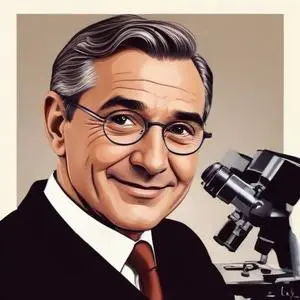
A pioneering cell biologist who discovered the structure and function of cells, particularly the role of lysosomes, and was awarded the Nobel Prize in Physiology or Medicine in 1974.
Albert Claude, a Belgian-American cell biologist and medical doctor, is renowned for sharing the Nobel Prize in Physiology or Medicine in 1974 with Christian de Duve and George Emil Palade. His pioneering work in cell biology led to the discovery of various cell organelles, including mitochondria, chloroplast, endoplasmic reticulum, Golgi apparatus, ribosome, and lysosome, revolutionizing our understanding of cellular structure and function.
Born on August 24, 1899, in Longlier, Belgium, Claude's elementary education began at a comprehensive primary school in his birthplace. During World War I, he served in the British Intelligence Service and was imprisoned in concentration camps twice. In recognition of his service, he was granted enrollment at the University of Liège in Belgium to study medicine without formal education requirements, earning his Doctor of Medicine degree in 1928.
Claude's passion for medical research led him to join German institutes in Berlin initially, but in 1929, he seized the opportunity to join the Rockefeller Institute in New York. At Rockefeller University, he made his most groundbreaking achievements in cell biology, including the development of the technique of cell fractionation in 1930. This innovative approach enabled him to discover the agent of the Rous sarcoma, as well as components of cell organelles.
Claude's pioneering works earned him numerous awards and honors, including:
Claude served as director at several prestigious institutions, including the Jules Bordet Institute for Cancer Research and Treatment and Laboratoire de Biologie Cellulaire et Cancrologie in Louvain-la-Neuve. He was also a professor at the Free University of Brussels, the University of Louvain, and Rockefeller University.
Albert Claude's groundbreaking contributions to cell biology have had a profound impact on modern medicine and our understanding of cellular function. His pioneering works continue to inspire and influence scientists, researchers, and medical professionals worldwide.
Born in 1917
A Nobel Prize-winning scientist who discovered and characterized lysosomes, the cell's recycling centers, and made significant contributions to our understanding of cellular biology. His work has far-reaching implications for medicine and our understanding of life processes.
Born in 1920
A French biologist and geneticist who discovered the mechanism of gene regulation, pioneering the field of molecular biology. He won the Nobel Prize in Physiology or Medicine in 1965 for his work on the genetic control of enzyme synthesis.
Born in 1910
A French biochemist and geneticist who discovered the mechanism of gene regulation, earning a Nobel Prize in Physiology or Medicine in 1965. He's also known for his book "Chance and Necessity," which explores the philosophical implications of modern biology.
Born in 1901
A pioneer in microbiology and environmentalism, he explored the interconnectedness of humans and their ecosystem, advocating for a holistic approach to health and conservation.
Born in 1925
A pioneering geneticist who discovered bacterial gene recombination and transduction, revolutionizing our understanding of genetic inheritance and earning a Nobel Prize.
