


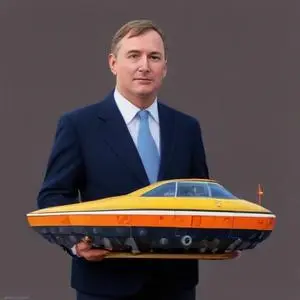
The inventor of the hovercraft, a revolutionary transportation vehicle that can travel over water and land, is credited with creating a new mode of transportation that has transformed industries such as search and rescue, military, and tourism.
Christopher Cockerell is renowned for his groundbreaking invention, the hovercraft, a mode of transportation that revolutionized the world of engineering and beyond. This innovative contraption, which uses air pressure to create lift and propulsion, has been instrumental in transforming the way we travel and transport goods.
Born on June 4, 1910, in Cambridge, England, Cockerell was the son of Sir Sydney Cockerell, a curator at the Fitzwilliam Museum, and Florence Kingsford Cockerell, an illustrator and designer. He attended Gresham's School in Holt, Norfolk, and later matriculated at Peterhouse, Cambridge, where he studied mechanical engineering.
Cockerell began his career as a post-graduate pupil at W.H. Allen, Sons & Co. in Bedford, where he worked from 1931 to 1933. He then returned to the University of Cambridge to study radio and electronics, which laid the foundation for his future research endeavors. In 1935, he joined the Marconi Company, where he led a research team and contributed to the development of various systems, including radar and radio location technology.
After leaving the Marconi Company, Cockerell bought Ripplecraft Ltd., a small Norfolk boat and caravan hire company. It was during this time that he began to explore ways to increase the speed of his craft. Drawing inspiration from earlier work by the Thornycroft company, he experimented with partially raising a vessel out of the water using a small engine. This experimentation ultimately led to the creation of the hovercraft, his most notable invention.
Cockerell's contributions to engineering and innovation were recognized with numerous awards and honors. He was appointed a Commander of the Order of the British Empire (CBE) in 1969 and was elected a Fellow of the Royal Society (FRS) in 1970. He also received the Royal Designer for Industry (RDI) award in 1964.
Cockerell married Margaret Elinor Belsham in 1935, and they lived together until her passing in 1996. He passed away on June 1, 1999, leaving behind a legacy that continues to inspire engineers, inventors, and innovators around the world. His invention of the hovercraft has had a lasting impact on modern transportation, and his contributions to the field of engineering remain unparalleled.
Cockerell's remarkable life and achievements serve as a testament to the power of innovation and creativity. His contributions to the world of engineering and transportation continue to inspire new generations of inventors and innovators.
Born in 1881
Discovered penicillin, a revolutionary antibiotic, and pioneered its use in medicine. This breakthrough has saved countless lives and transformed the field of healthcare.
Born in 1806
A visionary engineer who revolutionized transportation with innovative designs, including the iconic Clifton Suspension Bridge, which transformed urban landscapes.
Born in 1781
Designed the Liverpool and Manchester Railway, a pioneering feat that revolutionized transportation and paved the way for modern rail networks.
Born in 1791
Pioneering scientist who discovered electromagnetic induction, formulated the laws of electrolysis, and invented the first electrical generator, revolutionizing our understanding of electricity and its applications.
Born in 1736
Improved steam engine efficiency, revolutionizing industry and transportation. Known for his innovative designs and patents that transformed the Industrial Revolution.
Born in 1771
Built steam-powered locomotives, revolutionizing land transportation, and pioneered the use of steam engines in mines.
Born in 1791
A pioneer in computer science, credited with inventing the first mechanical computer, the Difference Engine, and conceptualizing the Analytical Engine, a precursor to modern computers.
Born in 1888
Scottish engineer who pioneered the development of the first publicly demonstrated television system, revolutionizing entertainment and communication.
