


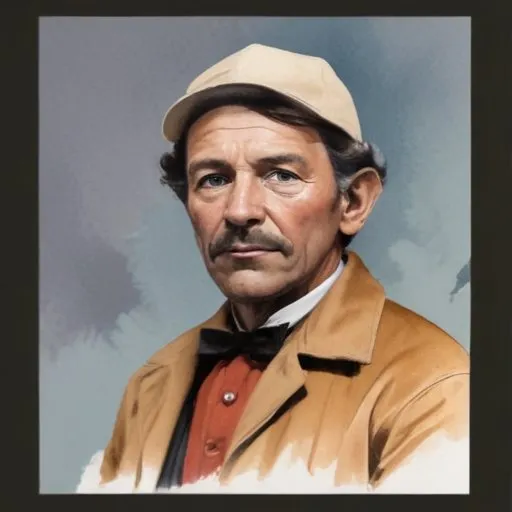
A pioneering geologist and mountaineer who explored the American West, uncovering its geological secrets and scaling its highest peaks. He's also known for his witty literary criticism.
Clarence King is renowned for being the first director of the United States Geological Survey (USGS) from 1879 to 1881, and for his groundbreaking exploration of the Sierra Nevada mountain range. His remarkable career spanned both geology and mountaineering, earning him recognition as a leading figure in the history of American science.
Born on January 6, 1842, in New York City, King was the son of James Rivers King and Florence Little King. Following his father's death in 1848, King was raised primarily by his mother, who encouraged his early interest in outdoor exploration and natural history. He attended schools in Boston, New Haven, and later the prestigious Hartford High School, where he excelled academically and athletically.
After a series of financial setbacks, King's mother married George S. Howland in 1860, and he financed King's enrollment in the Sheffield Scientific School affiliated with Yale College. It was at Yale that King developed a strong foundation in applied chemistry, physics, and geology, largely influenced by the esteemed geologist James Dwight Dana.
King's most notable achievement was his exploration of the Sierra Nevada mountain range, which led to the discovery of the Sierra Nevada Fault, a significant geological feature. His work in the Sierra Nevada was documented in his book Mountaineering in the Sierra Nevada, published in 1872. This seminal work not only showcased King's exceptional mountaineering skills but also provided valuable scientific insights into the geology of the region.
In 1879, King was appointed as the first director of the USGS, a position he held until 1881. During his tenure, he played a crucial role in shaping the organization's mission and objectives, establishing the foundation for the USGS's future success.
King's contributions to geology and mountaineering have had a lasting impact on modern society. His work in the Sierra Nevada paved the way for future geological exploration and research in the region. Moreover, his leadership at the USGS helped establish the organization as a premier scientific institution, enabling future generations of geologists to build upon his legacy.
King was a strong advocate for the importance of scientific exploration and research. He believed that understanding the natural world was essential for human progress and development. His work in geology and mountaineering was driven by a passion for discovery and a desire to contribute to the advancement of human knowledge.
Clarence King's life and work were shaped by the era in which he lived. The late 19th century was a time of unprecedented scientific discovery and exploration, and King was at the forefront of this movement. His legacy continues to inspire future generations of geologists, mountaineers, and scientists, serving as a testament to the power of human curiosity and ingenuity.
Today, King's work remains a vital part of American scientific heritage, and his contributions to our understanding of the natural world continue to influence contemporary research and exploration.
Born in 1834
Led a groundbreaking expedition down the Colorado River, mapping the Grand Canyon and making significant geological discoveries. He's considered one of the most important figures in the exploration of the American West.
Born in 1843
Pioneering geologist who revolutionized the field with groundbreaking research on plate tectonics, earthquakes, and the geological history of the American West.
Born in 1825
A British explorer who traveled to the Amazon rainforest and discovered over 8,000 species, including butterflies, beetles, and birds, and is known for his theory of mimicry in nature.
Born in 1823
A pioneering naturalist who discovered evolution through natural selection, independently of Charles Darwin, and contributed significantly to the field of biogeography.
Born in 1809
Developed the theory of evolution through natural selection, revolutionizing our understanding of life on Earth. This groundbreaking idea transformed the fields of biology, ecology, and beyond.
Born in 1810
A pioneering botanist who contributed significantly to the development of American botany, particularly in the fields of plant classification and evolution.
Born in 1807
A pioneering scientist who studied fossils and glaciers, making groundbreaking discoveries about the Ice Age and the classification of species.
