


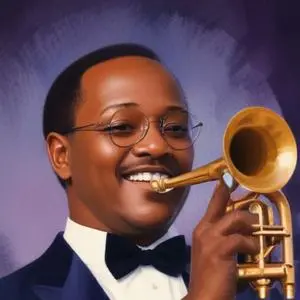
A legendary jazz trumpeter, composer, and educator who mentored Miles Davis and Quincy Jones, and is known for his virtuosic playing and innovative style.
Clark Terry, the virtuosic jazz trumpeter, is renowned for his prolific career spanning over 70 years, with over 900 recordings to his name. As a pioneer of the flugelhorn in jazz, Terry's contributions to the genre have left an indelible mark, earning him the respect of his peers and the admiration of generations of jazz enthusiasts.
Born on December 14, 1920, in St. Louis, Missouri, Terry was encouraged by his father to take up music at an early age. He began playing the valve trombone and later switched to trumpet, which would become his instrument of choice. Terry's professional career took off in the early 1940s, performing in local clubs and eventually joining the United States Navy during World War II, where he served as a bandsman.
Terry's big break came when he joined the Charlie Barnet Orchestra in 1947, followed by stints with Count Basie (1948-1951) and Duke Ellington (1951-1959). It was during his time with Ellington that Terry's reputation as a master musician solidified, with his versatility and technical prowess earning him the respect of his peers.
Terry's impact on the jazz world extends beyond his own performances. He mentored some of the most iconic jazz musicians, including Miles Davis, Herbie Hancock, Wynton Marsalis, Pat Metheny, Dianne Reeves, and Terri Lyne Carrington. Quincy Jones, who Terry informally taught during his frequent visits to Seattle with the Count Basie Sextet, often credits Terry as a key influence in his early career.
In 1962, Terry joined the Tonight Show Band on The Tonight Show, a position he held until 1972. This exposure cemented his status as a jazz legend, and his career continued to soar with performances alongside Oscar Peterson (1964-1996) and numerous collaborations with other jazz greats.
Terry's achievements have been recognized with numerous awards and honors, including multiple Grammy nominations, a Grammy Lifetime Achievement Award, and induction into the Jazz Hall of Fame.
Clark Terry's influence on modern jazz is immeasurable. His commitment to education and mentorship has inspired generations of musicians, and his contributions to the genre have helped shape its evolution. As a testament to his legacy, Terry's music continues to inspire and delight audiences around the world.
"The most important thing in playing jazz is to be able to swing. If you can't swing, you can't play jazz." - Clark Terry
Terry's wisdom and wit are reflected in his quotes, which offer insight into his approach to music and life.
Born in 1926
A legendary jazz musician who revolutionized the genre with his improvisational style and iconic albums like "Kind of Blue". He's synonymous with cool, jazzy sophistication.
Born in 1926
A legendary jazz saxophonist and composer who revolutionized the genre with his innovative, spiritually-driven improvisations and iconic albums like "A Love Supreme".
Born in 1917
A virtuosic trumpet player and composer who revolutionized jazz with his lightning-fast solos and iconic puffy cheeks, creating a new language for the instrument. He's synonymous with bebop and modern jazz.
Born in 1917
A jazz legend who revolutionized piano playing and composition with unorthodox techniques and harmonies, creating a unique, improvisational style that continues to inspire generations of musicians.
Born in 1920
A pioneering jazz saxophonist and composer, known for his lightning-fast solos and innovative bebop style that revolutionized jazz music. 82
Born in 1901
A legendary jazz musician who revolutionized the genre with his unique trumpet playing and raspy vocals, leaving an indelible mark on American music.
Born in 1899
A legendary jazz pianist, composer, and bandleader who revolutionized the genre with his unique style and iconic compositions, such as "Take the A Train" and "Mood Indigo".
Born in 1904
A legendary jazz pianist and bandleader who led a iconic orchestra, blending swing and blues to create a unique sound that influenced generations of musicians. Known for his distinctive "less-is-more" style and hits like "April in Paris" and "One O'Clock Jump".
