


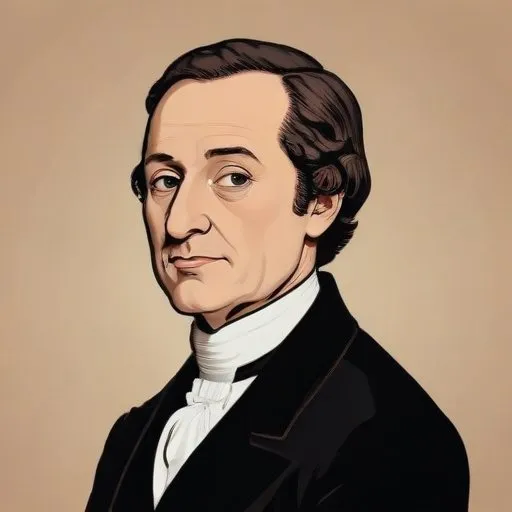
A French Enlightenment thinker who developed early socialist and technocratic ideas, advocating for a more equal and industrialized society. He's considered a precursor to modern sociology and organizational theory.
Claude Henri de Rouvroy, Comte de Saint-Simon, was a French philosopher, social reformer, and politician who is best known for his influential works on utopian socialism, industrialism, and the concept of "industrialism" as an alternative to the existing social and economic systems of his time. His groundbreaking ideas on social organization, economic development, and the role of science and technology in society have had a profound impact on modern thought and continue to shape our understanding of social and economic progress.
Saint-Simon was born on October 17, 1760, in Paris, France, into an aristocratic family with a long history of military and administrative service. Despite his privileged upbringing, Saint-Simon rejected the inherited titles and wealth, instead choosing to dedicate his life to the pursuit of knowledge, social reform, and human progress. This dichotomy between his aristocratic background and his radical ideas would shape his life and work, as he navigated the complexities of the French Revolution and its aftermath.
Saint-Simon's philosophical framework was characterized by a strong emphasis on reason, science, and the potential for human progress through technological advancement and social reorganization. He believed in the concept of "industrialism" as a means to harness the power of science and technology to create a more just and equal society. His ideas on the role of science and technology in driving social progress have had a lasting impact on the development of socialism, communism, and other progressive ideologies.
Saint-Simon's ideas have had a significant impact on the development of modern socialism, communism, and social democracy. His emphasis on the role of science and technology in driving social progress has influenced thinkers such as Karl Marx, Friedrich Engels, and Pierre-Joseph Proudhon.
Saint-Simon's life was marked by a series of key events and relationships that shaped his ideas and work. These include:
Saint-Simon's work and ideas have had a lasting impact on modern thought and continue to shape our understanding of social and economic progress. His emphasis on the role of science and technology in driving social progress has influenced generations of thinkers and reformers.
Today, Saint-Simon is remembered as a visionary philosopher and social reformer who dared to challenge the existing social and economic systems of his time. His ideas on industrialism, social organization, and the potential for human progress through technological advancement continue to inspire and shape our understanding of the world.
Born in 1712
A pioneering thinker who shaped modern democracy and education with his ideas on social contracts, general will, and the importance of early childhood education. His writings influenced the French Revolution and modern political thought.
Born in 1694
A witty and insightful 18th-century writer and philosopher who used satire to critique societal norms and advocate for reason, tolerance, and human rights.
Born in 1749
Developed nebular hypothesis of the origin of the solar system and formulated Laplace's equation, a fundamental concept in mathematics and physics. He's considered the founder of celestial mechanics.
61 Years Old
A lawyer and politician who served in the U.S. House of Representatives from 1987 to 1997, known for his moderate Republican views and advocacy for environmental issues.
Born in 1724
Developed influential philosophical frameworks, such as the Critique of Pure Reason, that shaped modern Western thought on ethics, morality, and human understanding.
