


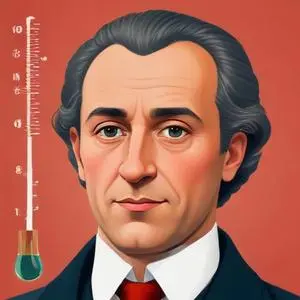
A Polish-German physicist and engineer who developed the Fahrenheit scale, a temperature measurement system still widely used today. He revolutionized the way we understand and measure heat and cold.
Daniel Gabriel Fahrenheit is celebrated as the inventor of the first reliable thermometer, revolutionizing the field of temperature measurement. His invention of the mercury-in-glass thermometer, which allowed for precise and consistent temperature readings, paved the way for significant advancements in various fields, including science, medicine, and engineering.
Fahrenheit was born on May 24, 1686, in Danzig, Poland, to a family of German extraction. His family had a rich mercantile background, with his great-grandfather having lived in Rostock and later settling in Danzig as a merchant in 1650.
Fahrenheit's early life took a dramatic turn when his parents died in 1701 due to eating poisonous mushrooms. He was placed under guardianship and later sent to Amsterdam for a four-year merchant trade apprenticeship.
Fahrenheit's fascination with science and instrument-making led him to focus on developing thermometers. He conducted extensive research on the properties of liquids, which enabled him to create thermometers that were both accurate and consistent.
In 1709, Fahrenheit invented the mercury-in-glass thermometer, which surpassed the accuracy of existing spirit-filled thermometers. This innovation marked a significant milestone in the history of temperature measurement.
Fahrenheit's thermometers quickly gained popularity, and his Fahrenheit scale became widely adopted. His instruments enabled scientists to compare temperature measurements with unprecedented precision, contributing significantly to the advancement of various scientific disciplines.
Fahrenheit's thermometer paved the way for numerous breakthroughs in fields such as medicine, engineering, and physics. Accurate temperature measurement enabled researchers to study the properties of materials, understand weather patterns, and develop new technologies.
In the medical field, Fahrenheit's thermometers allowed doctors to diagnose and monitor feverish patients more effectively, leading to improved healthcare outcomes.
Fahrenheit was elected as a Fellow of the Royal Society (FRS) in 1724, recognizing his outstanding contributions to the field of science.
In 1736, Fahrenheit died on September 16, at the age of 50, leaving behind a legacy that continues to shape our understanding of temperature measurement.
Daniel Gabriel Fahrenheit's groundbreaking work in temperature measurement has had a profound impact on modern society. His invention of the mercury-in-glass thermometer has enabled scientists to make precise measurements, driving innovation and discovery across various disciplines.
Fahrenheit's legacy serves as a testament to the power of human ingenuity, inspiring future generations of scientists and inventors to push the boundaries of knowledge and understanding.
Born in 1564
Pioneering astronomer, physicist, and mathematician who played a major role in the Scientific Revolution, making key discoveries that challenged Aristotelian views and laid the foundation for modern science.
Born in 1623
A 17th-century genius who made major contributions to mathematics, physics, and philosophy, inventing the mechanical calculator and developing the theory of probability. His writings also explored the human condition and faith.
Born in 1608
Developed the mercury barometer, a device that measures atmospheric pressure, and made significant contributions to the study of vacuums and fluids.
Born in 1701
A Swedish astronomer, physicist, and mathematician who developed the Celsius temperature scale, still widely used today to measure temperature. He also made significant contributions to astronomy, including the discovery of the aurora borealis.
Born in 1743
Father of modern chemistry, discovered oxygen, and developed a systematic method of chemical nomenclature. He laid the foundation for modern chemistry and paved the way for future scientific discoveries.
Born in 1745
Italian physicist who invented the first electrical battery, revolutionizing the field of electricity and paving the way for countless technological advancements.
Born in 1821
A 19th-century physician and physicist who made significant contributions to the fields of electromagnetism, thermodynamics, and the physiology of human perception, particularly in the study of vision and hearing.
