


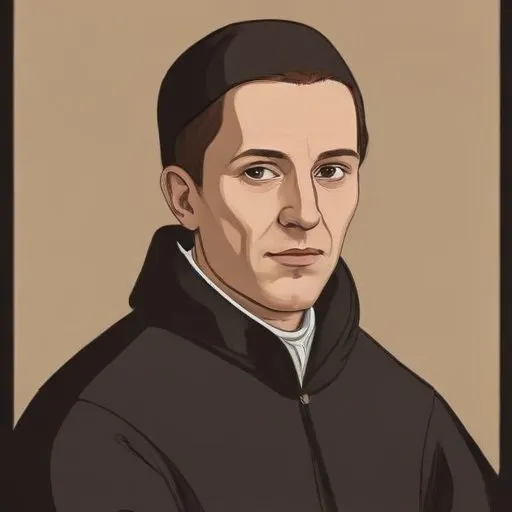
A Flemish Jesuit brother and painter who created exquisite floral still-life paintings that showcased his mastery of color and composition, influencing the development of 17th-century Flemish still-life art.
Daniel Seghers, a Flemish Jesuit brother and painter, is renowned for his breathtaking flower still lifes, particularly in the genre of flower garland painting. His exquisite works of art enthralled aristocratic patrons, inspiring numerous followers and imitators.
Born on December 3, 1590, in Antwerp, Seghers moved to the Dutch Republic, likely Utrecht, around 1601, following his father's death and his mother's conversion to Calvinism. It is suspected that he began his artistic training in Utrecht.
By 1611, Seghers had returned to Antwerp, where he was enrolled in the Guild of Saint Luke as a pupil of Jan Brueghel the Elder. This marked the beginning of his artistic journey, which would eventually lead him to become a master of flower garland paintings.
In 1614, Seghers reconverted to Catholicism and became a novice in the Jesuit order in Mechelen. This significant decision not only shaped his spiritual life but also influenced his artistic style and themes.
By 1621, Seghers was in Brussels, where he created two flower garland paintings for the Cathedral of St. Michael and St. Gudula. These early works showcased his growing talent and laid the foundation for his future masterpieces.
In 1625, Seghers took his final vows as a Jesuit priest and left for Rome, where he spent two years. During this period, he collaborated with prominent painters, including Nicolas Poussin and Domenichino, on various projects.
One of his notable works from this period is the "Double Wreath Surrounding a Medallion with the Triumph of Love," a stunning flower garland painting featuring putti by Domenichino.
In 1627, Seghers returned to Antwerp, where he continued to work as a painter for the remainder of his life. His studio became a hub of artistic activity, attracting visitors such as the Cardinal-Infante Ferdinand of Austria in 1635 and Archduke Leopold Wilhelm of Austria in 1641.
Seghers' flower garland paintings remain his most enduring legacy, captivating art lovers with their beauty, elegance, and intricate details. His contributions to the genre have inspired generations of artists, solidifying his position as a master of still life painting.
Throughout his life, Seghers received numerous accolades and recognition for his art. His work was highly sought after by aristocratic patrons, and he was patronized by the Jesuit order, which commissioned many of his paintings.
Daniel Seghers' artistic innovations and contributions to the genre of flower garland painting have had a lasting impact on the art world. His work continues to inspire artists, art historians, and enthusiasts alike, ensuring his legacy as a master of still life painting.
Today, Seghers' paintings are held in high esteem, with many of his works featured in prominent museums and private collections around the world. His art is a testament to his skill, creativity, and devotion to his craft, inspiring future generations to continue his legacy.
Born in 1577
A renowned Flemish painter and diplomat, famous for his vivid and emotive Baroque-style masterpieces, particularly his lush nudes and dramatic altarpieces.
Born in 1599
A renowned Flemish-English painter and etcher, famous for capturing the essence of 17th-century European aristocracy through his exquisite portraits, characterized by dramatic lighting and subtle emotional depth.
Born in 1579
A Flemish master of still life and animal painting, known for his vivid and intricate depictions of fruit, game, and market scenes. His works often featured in collaboration with other prominent artists of the time.
Born in 1597
A Flemish master of Baroque art, renowned for his vivid and emotive depictions of mythological and biblical scenes, as well as his innovative etchings.
Born in 1597
A Flemish Baroque painter, known for his dramatic and emotive depictions of mythological and biblical scenes, often featuring intense lighting and vivid colors.
