


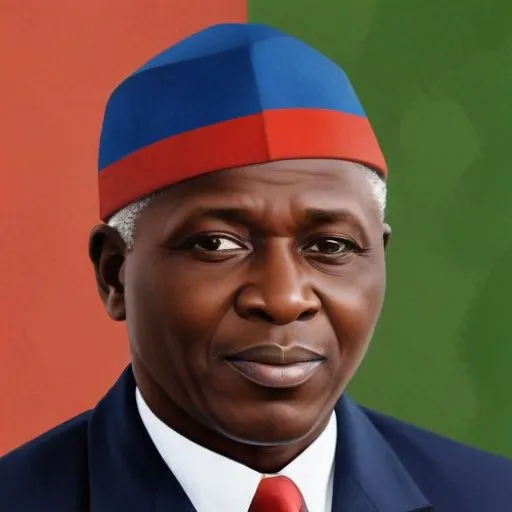
First president of an African country, leading it to independence from British colonial rule and establishing a democratic government. Known for his efforts to promote economic development and human rights.
Sir Dawda Kairaba Jawara, a name synonymous with The Gambia's struggle for independence and its journey towards democracy, is renowned for his unwavering dedication to his country and its people. As the first President of The Gambia, Jawara played a pivotal role in shaping the nation's history, paving the way for its transition from a British colony to a sovereign state.
Born on May 16, 1924, in Barajally, MacCarthy Island Division, Jawara's early life was marked by a strong desire for knowledge and education. He received his primary education at the Methodist Boys School in Banjul (then Bathurst) and later attended Achimota College in Ghana. His academic pursuits continued at the University of Glasgow's School of Veterinary Medicine, where he trained as a veterinary surgeon. He further honed his skills at the University of Liverpool and the University of Edinburgh.
After returning to The Gambia in 1953, Jawara began his career as a veterinary officer. However, his entry into politics marked a significant shift in his life's trajectory. He became the secretary of the newly formed People's Progressive Party (PPP) and was elected to the House of Representatives in 1960. His leadership skills and vision soon propelled him to become the leader of the PPP, and subsequently, the country's first Prime Minister in 1962.
Under Jawara's leadership, The Gambia gained independence from the United Kingdom on February 18, 1965. This monumental feat was a testament to his unwavering commitment to his country's freedom and self-governance. During this period, Elizabeth II remained the head of state as Queen of The Gambia, with Jawara serving as Prime Minister.
In 1970, The Gambia became a republic, and Jawara was elected as its first President. His presidency was marked by several significant events, including the attempted coup d'état in 1981, which resulted in the deaths of 400 to 800 people. In response, Jawara and Senegalese President Abdou Diouf announced the creation of the Senegambia Confederation, a union that aimed to strengthen ties between the two nations. Although the confederation ultimately collapsed in 1989, it remains a significant milestone in the history of West African cooperation.
Jawara's rule came to an end in 1994, when a military coup led by Yahya Jammeh seized power. Forced into exile, Jawara spent several years away from his homeland. However, he returned to The Gambia in 2002 and lived in retirement until his passing on August 27, 2019.
Dawda Jawara's life was a testament to his unrelenting dedication to The Gambia and its people. As a visionary leader, he played a pivotal role in shaping the nation's history, from its struggle for independence to its transition towards democracy. His legacy continues to inspire generations, serving as a beacon of hope and perseverance in the face of adversity.
Jawara's story is a powerful reminder that even in the face of adversity, courage, perseverance, and vision can triumph over daunting challenges. His life's work continues to inspire generations, serving as a testament to the power of leadership and dedication to one's country.
61 Years Old
A Gambian military officer who seized power in a 1994 coup and ruled with an iron fist for 22 years, known for his human rights abuses and eccentric behavior.
Born in 1922
First President of Tanzania, led the country to independence from British colonial rule and implemented socialist policies, known for his Pan-Africanism and anti-colonialism efforts.
Born in 1909
First President of Ghana, leading the country to independence from British colonial rule and promoting Pan-Africanism. He's known for his vision of a united Africa and his role in shaping modern Ghana.
Born in 1915
First President of Mali, leading the country to independence from France in 1960 and implementing socialist policies. Known for his efforts to modernize and unify the country.
Born in 1926
The 3rd President of Senegal, a renowned academic and politician, served from 2000 to 2012, implementing economic reforms and promoting regional stability. He's known for his efforts to modernize Senegal's infrastructure and economy.
89 Years Old
A Nigerian general and politician who served as the 5th President of Nigeria, known for his efforts to stabilize the country's economy and promote democracy. He's also known for his role in brokering peace in several African countries.
