


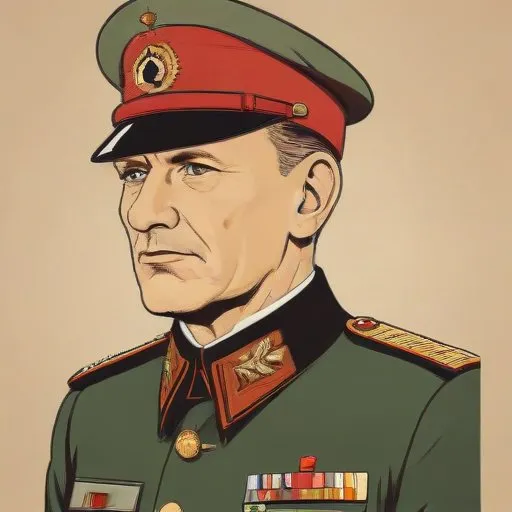
The German general who disobeyed Hitler's orders to destroy Paris, saving the city from devastation and earning the nickname "The Saviour of Paris". He later surrendered to the Allies, contributing to the war's end.
Dietrich von Choltitz, a German general, is best known for disobeying Adolf Hitler's orders to destroy Paris in 1944, earning him the nickname "The Savior of Paris." This daring act of defiance not only saved the city from destruction but also marked a turning point in World War II.
Born on November 9, 1894, in the Kingdom of Prussia, Dietrich von Choltitz came from a long line of military officers. He joined the Royal Saxon Army at a young age and saw service on the Western Front during World War I, eventually rising to the rank of Leutnant by the end of the war.
In the interwar period, Choltitz played a significant role in rebuilding Germany's armed forces. During World War II, he served in the Wehrmacht, participating in the invasion of Poland in 1939 and the Battle of Rotterdam in 1940, where he made a daring air landing and seized key bridges.
In 1944, Choltitz was appointed the commander of Nazi-occupied Paris. As the Allies approached the city, Hitler ordered Choltitz to destroy Paris, but Choltitz refused, believing the order to be militarily futile and culturally devastating. Instead, he surrendered the city to the Free French forces on August 25, 1944, saving Paris from destruction.
Dietrich von Choltitz's bravery and defiance in the face of overwhelming pressure have made him a legendary figure in history. His decision to spare Paris has had a lasting impact on the city and the world, preserving its cultural heritage for future generations.
"I will not destroy Paris. I will not be a party to the destruction of the greatest city in the world."
While many Nazi officers were loyal to Hitler and carried out his brutal orders, Choltitz's actions set him apart as a rare example of moral courage and humanity in the face of tyranny.
In the aftermath of World War II, Choltitz's actions were hailed as a heroic act of defiance against the Nazi regime. Today, he is remembered as a complex figure, both a product of his time and a beacon of hope in the darkest of hours.
Born in 1889
The dictator of Nazi Germany, responsible for the genocide of six million Jews and millions of other people during World War II, and infamous for his extreme nationalist and anti-Semitic ideology.
Born in 1891
A renowned World War II military strategist, known for leading the Afrika Korps and earning the respect of both allies and enemies with his tactical genius.
Born in 1900
Leading the SS and Gestapo, he oversaw the Nazi regime's brutal security apparatus and implemented the "Final Solution," orchestrating the genocide of six million Jews during World War II.
Born in 1893
A high-ranking Nazi official, he was a decorated World War I fighter pilot and later became a prominent politician, serving as Minister President of Prussia. He's infamous for his role in the Nazi regime and war crimes trials.
Born in 1893
A German diplomat who served as the Nazi regime's Foreign Minister, orchestrating key alliances and treaties that led to World War II. He was a close associate of Adolf Hitler and played a crucial role in shaping Nazi foreign policy.
Born in 1891
A German naval commander who led the U-boat fleet during World War II and briefly served as President of Germany after Hitler's death, known for his role in the war and its aftermath.
Born in 1876
A German naval leader who played a key role in the Kriegsmarine during World War II, overseeing the German U-boat fleet and naval operations. He was a close advisor to Adolf Hitler and implemented the German naval strategy during the war.
Born in 1891
A skilled and highly decorated military leader, known for his tactical genius and defensive strategies during World War II, earning him the respect of both his allies and enemies.
