


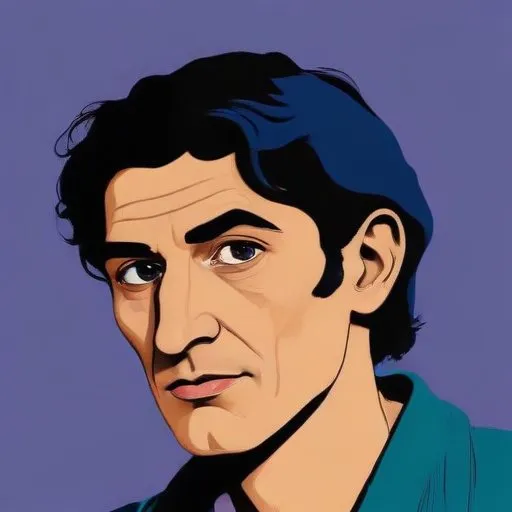
A Greek poet celebrated for his poignant and introspective works that explore themes of love, identity, and human connection, often blending elements of mythology and modernity.
Dinos Christianopoulos, a celebrated Greek poet, novelist, folklorist, and scholar, is widely known for his thought-provoking works that have left an indelible mark on the literary world. His famous couplet, "They tried to bury us. They didn't know we were seeds," has become a symbol of resilience and hope, resonating with readers across the globe.
Born as Konstantinos Dimitriadis on March 20, 1931, in Thessaloniki, Greece, Christianopoulos was the son of a refugee from East Thrace. He pursued his degree in Classical Studies from the Aristotle University of Thessaloniki, graduating in 1955. During his university years, he developed a strong foundation in literature, which would later shape his writing style and inspire his works.
Christianopoulos' literary journey began in 1947 with the publication of his first poem, "Age of Lean Cows." His early works were heavily influenced by the likes of Constantine P. Cavafy and T.S. Eliot, two renowned poets of the time. Over the years, he continued to produce remarkable works, including "Indefensible Yearning" (1960), "Fresh Water Stories" (1980), and "The Body and the Wormwood" (1994).
Christianopoulos remained private about his personal life, particularly his sexuality. Despite being gay, he never openly claimed his sexual orientation. Throughout his life, he dedicated himself to his literary pursuits, leaving behind a legacy of thought-provoking works.
After his passing on August 11, 2020, at the age of 89, Christianopoulos' work was donated to the Aristotle University of Thessaloniki, ensuring that his literary legacy would continue to inspire future generations. His contributions to Greek literature remain unparalleled, and his iconic couplet continues to be a beacon of hope and resilience in the face of adversity.
Christianopoulos' works are replete with poignant quotes and memorable sayings, which have become an integral part of Greek literary heritage. Some of his notable quotes include:
Christianopoulos' works have had a profound impact on modern Greek society, inspiring countless readers and writers. His poetry and novels have been translated into multiple languages, cementing his position as a celebrated literary figure beyond Greece.
Through his life and works, Dinos Christianopoulos has left an indelible mark on the literary world, continuing to inspire generations to come. His legacy serves as a testament to the power of literature to transform and uplift humanity.
Born in 1911
A Greek poet and critic, renowned for his lyrical and evocative works that explored the human experience, mythology, and the Greek identity. His poetry is celebrated for its musicality and depth.
Born in 1900
A Greek poet and diplomat who won the Nobel Prize in Literature in 1963 for his lyrical and symbolic poetry that explored Greek identity and culture. His work is known for its evocative and introspective style.
Born in 1863
A renowned poet and journalist who crafted evocative, historically-inspired verses that probed the human condition, exploring themes of love, identity, and mortality. His unique style blended ancient and modern elements, earning him a devoted following.
Born in 1884
A leading figure in the Greek literary revival of the 20th century, known for blending folk traditions with modernist experimentation in his poetry and plays. His work explores themes of identity, mythology, and the human condition.
Born in 1859
A leading figure of the Greek literary generation of the 1880s, he wrote influential poetry and plays that explored themes of Greek identity and national revival. His works are considered cornerstones of modern Greek literature.
Born in 1922
A provocative and influential artist who explored the intersection of politics, religion, and sexuality through his films, which often featured vivid imagery and unflinching social commentary.
Born in 1909
A celebrated Greek poet and playwright, known for his powerful and evocative works that often explored themes of love, politics, and the human condition. His poetry is characterized by its lyricism and accessibility.
Born in 1883
A Greek philosopher, author, and playwright who explored the human condition through novels like "Zorba the Greek" and "The Last Temptation of Christ", delving into themes of spirituality, morality, and individualism.
