


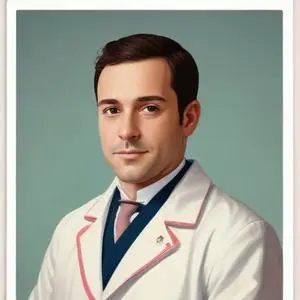
Pioneering military surgeon who developed the "flying ambulance" system, revolutionizing battlefield medical care.
Known as the "father of modern military surgery," Dominique Jean Larrey was a French surgeon and military doctor who revolutionized the way wounded soldiers were treated on the battlefield. His innovative techniques and triage system saved countless lives during the French Revolutionary Wars and the Napoleonic Wars, earning him a legendary status in the field of medicine.
Larrey was born on July 8, 1766, in the small village of Beaudan in the Pyrenees. Orphaned at the age of 13, he was raised by his uncle Alexis, who was the chief surgeon in Toulouse. This early exposure to medicine sparked Larrey's interest, and he went on to study under Pierre-Joseph Desault, the chief surgeon at the Hôtel-Dieu de Paris.
Larrey's early career took him to Brest, where he was appointed surgeon in the navy and began lecturing. In 1787, he boarded a ship deployed to the defense of Newfoundland, becoming the youngest medical officer in the French Royal Navy at just 21 years old. During his time in America, Larrey developed an interest in the local environment, writing observations that would later be published in his memoirs.
In 1789, Larrey returned to Paris, where he worked alongside prominent surgeons like Jean-Nicolas Corvisart, Xavier Bichat, and Raphaël Bienvenu Sabatier at Les Invalides. It was during this time that he improvised an ambulance to treat the wounded during the Storming of the Bastille.
Larrey's experiences during the French Revolutionary Wars led him to develop the modern method of army surgery, field hospitals, and the system of army ambulance corps. He adapted the carriages of the French flying artillery as "ambulance volantes" or flying ambulances, enabling rapid transportation of wounded soldiers to medical facilities.
Larrey's innovative techniques and triage system had a profound impact on the treatment of wounded soldiers. He is credited with saving countless lives and improving the overall efficiency of military medicine. His memoirs, "Mémoires de chirurgie militaire et campagnes du baron D.J. Larrey," remain a valuable resource for historians and medical professionals.
Larrey's legacy extends beyond his military contributions. He was a passionate advocate for the humane treatment of prisoners of war and the importance of medical ethics in wartime. His work paved the way for subsequent generations of military surgeons and continues to inspire medical professionals today.
Larrey's remarkable life and career serve as a testament to his unwavering dedication to the advancement of military surgery and the alleviation of human suffering. His pioneering spirit and innovative approaches continue to inspire generations of medical professionals, ensuring his legacy as one of the most important figures in the history of medicine.
Born in 1769
A French military leader who rose to prominence during the French Revolution and became Emperor of France, known for his military conquests and reorganization of Europe. He is also famous for his Napoleonic Code, which remains a foundation of modern law.
Born in 1768
Developed the Fourier series, a mathematical tool used to decompose periodic functions into their component frequencies, and pioneered the study of heat transfer and thermodynamics.
Born in 1769
Founded the field of comparative anatomy, establishing extinction as a fact and creating a framework for understanding the natural world through fossil records.
Born in 1775
A pioneer in the field of electromagnetism, he formulated fundamental laws that describe the relationship between electric currents and magnetic fields. His work laid the foundation for many modern technologies, including electric motors and generators.
Born in 1749
Developed nebular hypothesis of the origin of the solar system and formulated Laplace's equation, a fundamental concept in mathematics and physics. He's considered the founder of celestial mechanics.
Born in 1744
A French soldier, biologist, and academic who developed a theory of inheritance of acquired characteristics, proposing that organisms adapt to their environment and pass on those traits to their offspring.
Born in 1801
French politician and minister of education who introduced significant reforms to the country's education system, making it more accessible and secular.
Born in 1822
Developed vaccines for rabies and anthrax, and pioneered the germ theory of disease, revolutionizing our understanding of microbiology and disease prevention.
