


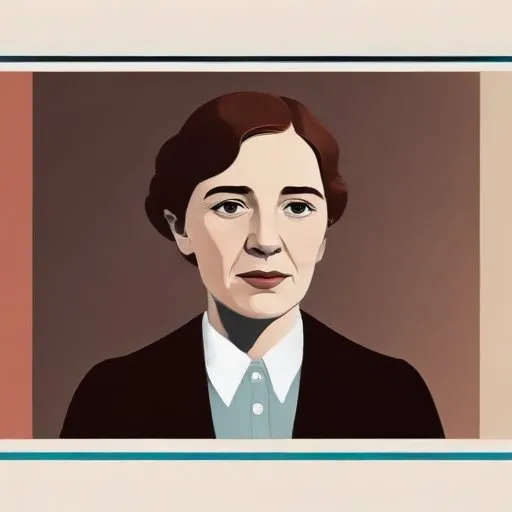
Pioneering mathematician, biochemist, and philosopher who developed the theory of cyclols, a model for protein structure, and made significant contributions to the fields of mathematics, chemistry, and philosophy.
Dorothy Maud Wrinch, a British mathematician and biochemical theorist, left an indelible mark on the scientific community with her groundbreaking attempt to deduce protein structure using mathematical principles. Her pioneering work on the cyclol hypothesis, a controversial theory that proposed a new understanding of protein structure, continues to fascinate researchers to this day.
Born on September 12, 1894, in Rosario, Argentina, to Hugh Edward Hart Wrinch, an engineer, and Ada Souter, Dorothy grew up in Surbiton, near London, after her family returned to England. She attended Surbiton High School and later entered Girton College, Cambridge, in 1913 to read mathematics.
Dorothy's time at Cambridge was marked by her involvement with the Heretics Club, run by Charles Kay Ogden, where she first heard Bertrand Russell speak in 1914. She graduated in 1916 as a wrangler and went on to take the Cambridge Moral Sciences tripos, studying mathematical logic with Russell in London.
In December 1916, Dorothy was invited to Garsington Manor, the home of Russell's mistress, Ottoline Morell, where she met prominent figures of the Bloomsbury Group, including Clive Bell. Her association with Russell continued, and she introduced him to Dora Black, who would later become his second wife. When Russell was imprisoned for his anti-war activities in 1918, Dorothy assisted him with his writing projects, bringing him books and articles.
In 1921, Dorothy facilitated the publication of Ludwig Wittgenstein's Tractatus, a seminal work in philosophical logic, in a German philosophical journal. Her own work on protein structure, particularly her advocacy for the cyclol hypothesis, sparked intense debate within the scientific community.
Dorothy Maud Wrinch's remarkable journey, marked by her intellectual fearlessness and her willingness to challenge established theories, continues to inspire researchers and scholars today. Her work on protein structure, though controversial in her time, has paved the way for future breakthroughs in the fields of biochemistry and molecular biology.
Dorothy Maud Wrinch's pioneering work on protein structure has had a lasting impact on our understanding of biochemistry and molecular biology. Her legacy continues to inspire researchers, encouraging them to push the boundaries of human knowledge and challenge established theories.
Dorothy's association with Bertrand Russell and her involvement with the Heretics Club reflect her commitment to intellectual freedom and her willingness to engage with unconventional ideas. Her own work on protein structure embodies the spirit of inquiry and intellectual curiosity that defines her philosophical outlook.
Born in 1920
A British scientist who contributed significantly to the discovery of the structure of DNA, providing high-quality X-ray crystallography images that helped James Watson and Francis Crick develop their famous model.
Born in 1903
Pioneering Irish crystallographer and first female Fellow of the Royal Society, known for her groundbreaking work on the structure of diamonds and benzene, and her advocacy for women in science.
Born in 1910
A pioneering scientist who deciphered the structures of biomolecules like insulin and vitamin B12, revolutionizing our understanding of biology and medicine.
Born in 1914
Pioneering crystallographer who unraveled the structure of hemoglobin, revolutionizing our understanding of biological molecules. His work paved the way for major advances in medicine and biochemistry.
Born in 1901
Pioneering crystallographer and physicist who pioneered X-ray crystallography, uncovering the structure of biological molecules like proteins and viruses.
Born in 1916
Pioneering scientist who discovered the structure of DNA, revolutionizing our understanding of genetics and life itself.
98 Years Old
Discovered the structure of DNA, revolutionizing our understanding of genetics and earning a Nobel Prize. Pioneering work in molecular biology has far-reaching implications for medicine and beyond.
Born in 1901
Pioneering chemist and peace activist who won two unshared Nobel Prizes, one for chemistry and one for peace, for his groundbreaking work on the nature of the chemical bond and his tireless efforts to promote nuclear disarmament.
