


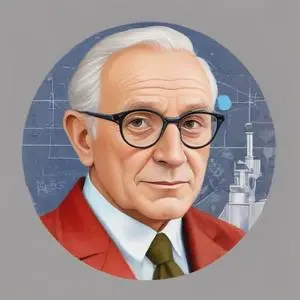
A Nobel Prize-winning biochemist who discovered the mechanism of protein phosphorylation, a crucial process that regulates various cellular functions, and made significant contributions to our understanding of cellular signaling pathways.
When it comes to understanding the intricacies of protein phosphorylation, one name stands out among the rest – Edmond H. Fischer. This Swiss-American biochemist, together with his collaborator Edwin G. Krebs, was awarded the Nobel Prize in Physiology or Medicine in 1992 for their groundbreaking discovery of how reversible phosphorylation works as a switch to activate proteins and regulate various cellular processes.
Fischer's work has had a profound impact on our comprehension of cellular signaling, and his legacy continues to inspire generations of scientists and researchers.
Edmond H. Fischer was born on April 6, 1920, in the Shanghai International Settlement, China, to a diverse family with roots in France, Austria, and Switzerland. His early years were marked by a strong foundation in education, with his attendance at the Swiss boarding school La Chtaigneraie, near his mother's hometown in Vevey. It was during this time that he developed a passion for mountain climbing and skiing.
Fischer's academic pursuits led him to the University of Geneva, where he studied chemistry during World War II. Despite his initial desire to study microbiology, inspired by the works of Louis Pasteur, he was advised to focus on chemistry. This decision would ultimately shape his future research endeavors.
Fischer's most notable contribution to the field of biochemistry is his discovery of the mechanism of reversible phosphorylation. This breakthrough research, conducted in collaboration with Edwin G. Krebs, provided a fundamental understanding of cellular signaling and its role in regulating various biological processes.
This pioneering work earned Fischer and Krebs the Nobel Prize in Physiology or Medicine in 1992. The significance of their discovery extends far beyond the scientific community, with implications for the development of new treatments for diseases such as cancer and diabetes.
Throughout his career, Fischer demonstrated a strong commitment to promoting education and cultural understanding. From 2007 to 2014, he served as the Honorary President of the World Cultural Council, an organization dedicated to fostering international cooperation and cultural exchange.
Edmond H. Fischer's remarkable life was marked by numerous accomplishments, including his ascent to becoming the oldest living Nobel Prize laureate at the time of his passing in 2021, at the age of 101.
Fischer's legacy extends beyond his scientific contributions, inspiring future generations of researchers and scientists to pursue careers in biochemistry and related fields. His dedication to education and cultural understanding serves as a testament to his commitment to making a positive impact on the world.
Edmond H. Fischer's remarkable life and legacy serve as a testament to the power of dedication, hard work, and a passion for discovery. His contributions to the field of biochemistry continue to inspire and shape the scientific community, ensuring his impact will be felt for generations to come.
70 Years Old
Discovered the structure and function of ion channels in cell membranes, revolutionizing our understanding of nerve and muscle function.
79 Years Old
A pioneering scientist who discovered the genes responsible for our sense of smell, leading to a deeper understanding of the human olfactory system. Her groundbreaking work has far-reaching implications for fields like neuroscience and medicine.
Born in 1920
A French biologist and geneticist who discovered the mechanism of gene regulation, pioneering the field of molecular biology. He won the Nobel Prize in Physiology or Medicine in 1965 for his work on the genetic control of enzyme synthesis.
Born in 1910
A French biochemist and geneticist who discovered the mechanism of gene regulation, earning a Nobel Prize in Physiology or Medicine in 1965. He's also known for his book "Chance and Necessity," which explores the philosophical implications of modern biology.
