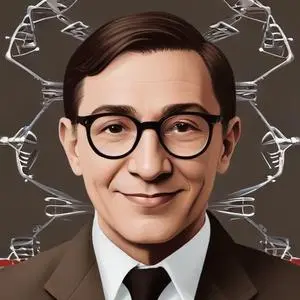
Edward B. Lewis

Edward B. Lewis

Edward B. Lewis was born on May 20th, 1918

Full Name: Edward Butts Lewis
Profession: Biologist
Nationality: American
Notable Award: Nobel Prize
Field of Study: Genetics
Academic Affiliation: California Institute of Technology
Birth Date: May 20, 1918
Death Date: July 21, 2004

A pioneering biologist who discovered the genetic mechanisms controlling embryonic development, earning a Nobel Prize in Physiology or Medicine in 1995. His work has far-reaching implications for understanding birth defects and cancer.

Written by: David Williams David Williams

Edward B. Lewis is renowned for his groundbreaking contributions to the field of genetics, specifically in the area of evolutionary developmental biology. He is best known for his pioneering work on the genetic control of development, which earned him the prestigious Nobel Prize in Physiology or Medicine in 1995.

Born on May 20, 1918, in Wilkes-Barre, Pennsylvania, Lewis was the second son of Laura Mary Lewis (née Histed) and Edward Butts Lewis, a watchmaker-jeweler. He graduated from E. L. Meyers High School and went on to pursue his higher education at the University of Minnesota, where he earned a BA in Biostatistics in 1939. During his time at the university, Lewis worked on Drosophila melanogaster in the lab of C.P. Oliver, which sparked his interest in genetics.

Lewis's academic pursuits continued at the California Institute of Technology (Caltech), where he earned his PhD in 1942 under the guidance of Alfred Sturtevant. His research focused on the genetic control of development, a subject that would become the hallmark of his career. After completing his PhD, Lewis enrolled in the U.S. Army Air Corps training program in meteorology and later received his master's degree in the area. During his military service, he worked as a weather forecaster in Hawaii and Okinawa for four years.

After the war, Lewis returned to Caltech in 1946 and took up a position as an instructor. He was promoted to professor in 1956 and later became the Thomas Hunt Morgan Professor of Biology in 1966. His research continued to focus on the genetic control of development, and he made several significant discoveries that shed light on the mechanisms of gene regulation.

In 1946, Lewis met Pamela Harrah, an accomplished artist and genetics enthusiast. They married and had three sons, Glenn, Hugh, and Keith. Pamela Harrah Lewis was not only a supportive partner but also a talented scientist in her own right, having discovered the mutant Polycomb, which is crucial in understanding gene regulation.

Edward B. Lewis's contributions to genetics and evolutionary developmental biology have had a profound impact on our understanding of life sciences. His work has paved the way for further research in the field, and his discoveries continue to inspire scientists and researchers today. Lewis's legacy extends beyond the scientific community, as his work has far-reaching implications for our understanding of human development and disease.

  • Nobel Prize in Physiology or Medicine (1995)
  • Thomas Hunt Morgan Professor of Biology (1966)

  • "The most important thing in science is to ask the right question."
  • "Genetics is not just about understanding how things work, but also about understanding how they evolve."

Edward B. Lewis's work has been instrumental in shaping our understanding of evolutionary developmental biology. His research has contributed to a deeper understanding of the genetic control of development, and his discoveries have paved the way for further research in the field. Lewis's legacy continues to inspire scientists and researchers, ensuring that his work will have a lasting impact on the life sciences.

Timeline
1918
Born in USA
Edward B. Lewis was born on May 20, 1918, in Wilkes-Barre, Pennsylvania, USA. He would go on to become an American biologist, geneticist, and academic.
1939
Graduated from Wesleyan University
Lewis graduated from Wesleyan University with a degree in biostatistics.
1955
Discovered Genetic Mechanisms
Lewis discovered the genetic mechanisms that control the development of fruit flies.
1983
Awarded Nobel Prize
Lewis was awarded the Nobel Prize in Physiology or Medicine for his discoveries on the genetic control of embryonic development.
2004
Passed Away
Edward B. Lewis passed away on July 21, 2004, at the age of 86.
Edward B. Lewis

Edward B. Lewis Quiz

What is the primary area of research that led to Edward B. Lewis's Nobel Prize in Physiology or Medicine?

Score: 0/5
FAQ
What was Edward B. Lewiss most notable discovery?
Edward B. Lewis was a Nobel Prize-winning biologist who made a groundbreaking discovery about the genetic control of embryonic development. His work on the bithorax complex has had a lasting impact on our understanding of gene regulation.
What were Edward B. Lewiss contributions to genetics?
Edward B. Lewis was a pioneering geneticist who made significant contributions to our understanding of gene regulation, embryonic development, and the genetic basis of cancer. His work has had a profound impact on the field of genetics.
How did Edward B. Lewiss research impact our understanding of cancer?
Edward B. Lewiss research on the genetic basis of cancer has led to a greater understanding of the molecular mechanisms underlying the disease. His work has paved the way for the development of new cancer therapies and treatments.
What awards did Edward B. Lewis receive for his work?
Edward B. Lewis was awarded the Nobel Prize in Physiology or Medicine in 1995 for his discovery of the genetic control of embryonic development. He also received numerous other awards and honors for his contributions to genetics and cancer research.
How is Edward B. Lewis remembered in the scientific community?
Edward B. Lewis is remembered in the scientific community as a pioneering geneticist and biologist who made significant contributions to our understanding of gene regulation and embryonic development. His legacy continues to inspire new generations of scientists.

Related People:

Christian de Duve

Born in 1917

A Nobel Prize-winning scientist who discovered and characterized lysosomes, the cell's recycling centers, and made significant contributions to our understanding of cellular biology. His work has far-reaching implications for medicine and our understanding of life processes.

François Jacob

Born in 1920

A French biologist and geneticist who discovered the mechanism of gene regulation, pioneering the field of molecular biology. He won the Nobel Prize in Physiology or Medicine in 1965 for his work on the genetic control of enzyme synthesis.

Joshua Lederberg

Born in 1925

A pioneering geneticist who discovered bacterial gene recombination and transduction, revolutionizing our understanding of genetic inheritance and earning a Nobel Prize.

Barbara McClintock

Born in 1902

Pioneering geneticist who discovered transposons, mobile genetic elements that jump from one location to another in a genome, revolutionizing our understanding of genetic variation and evolution.

James Watson

98 Years Old

Discovered the structure of DNA, revolutionizing our understanding of genetics and earning a Nobel Prize. Pioneering work in molecular biology has far-reaching implications for medicine and beyond.

Francis Crick

Born in 1916

Pioneering scientist who discovered the structure of DNA, revolutionizing our understanding of genetics and life itself.

Rosalind Franklin

Born in 1920

A British scientist who contributed significantly to the discovery of the structure of DNA, providing high-quality X-ray crystallography images that helped James Watson and Francis Crick develop their famous model.

Linus Pauling

Born in 1901

Pioneering chemist and peace activist who won two unshared Nobel Prizes, one for chemistry and one for peace, for his groundbreaking work on the nature of the chemical bond and his tireless efforts to promote nuclear disarmament.